Tuesday, November 30, 2010

A Christmas Gift to Remember

The topic for the December 10th installment of the Advent Calendar of Christmas Memories hosted by Thomas MacEntee is: "Christmas Gifts. What were your favorite gifts, both to receive and to give?"

Probably the most unusual and most memorable Christmas gift I ever received, though not necessarily my all-time favorite, was a present from my 14-year old sister in 1968. As you can see by the picture, it was a very large box, the biggest one "under" the Christmas tree. In fact, so big it couldn't fit under the tree!

I opened the box, and inside was another box. And inside that one was another box! And another, and another! Six in all. The box that actually held the gift was only about 4x4 inches. By the time I opened the final box, it really didn't matter what was in it. We had so much fun with getting to it. But, what was it you ask? A watch. Actually, a broken watch. It was a watch that didn't work! Not only was this a surprise to me, but to my sister as well. Being only 14 years old, she didn't have much money, and had gotten the watch from a friend. It didn't matter. As they say, it's the thought that counts, and a great deal of thought (and effort) had gone into that gift. Favorite gift, no. Memorable, yes!

Wednesday, November 24, 2010

- Off to a snowy start

Near record amounts of snow fell at Paradise in December and early January. The weather station there recorded over 360 inches (over 30 feet) of the white stuff so far this fall and winter. At that rate, the mountain is on track to break the previous snowfall record (93 feet in 1972)... The breakneck pace of snowfall has blanketed the entire Cascade range and has also caused a significant amount of avalanche distress and accidents. The thick unstable snowpack brought a series of severe avalanche cycles that have claimed nine lives in the region. Almost another record, yet very grim, for avalanche fatalities.

At Paradise on Mount Rainier, a snowshoer was caught in a snow-slide on December 18th. It took 3 and 1/2 days to find 22 year old Kirk Reiser. Though the accident occurred within 3/4 miles of the parking lot, a tremendous amount of continued snowfall made the recovery hazardous and arduous. To find him, we called upon Mountain Rescue and Crystal Mountain Ski Patrol to help. They showed up with many rescuers, search dogs and bombs (to mitigate the hazard). Left: Crystal Mountain Ski Patroller Chris Morin tossing a bomb, photo by Stefan Lofgren.

It's been over 20 years since someone has been caught and killed in a "winter" related avalanche on the Paradise side of the mountain. Climbers have certainly been caught, but those incidents happened in the spring and fall at higher elevations. The last four avalanche fatalities were in June (3) and October (1), not your traditional "avalanche season." Left: Mountain Rescue volunteers working a probe-line, photo by Stefan Lofgren.

Anyone who leaves the parking lot for a day of fun in the snow should definitely pay attention and adhere to the avalanche forecast. You'll also need to know how to evaluate the hazard and make route finding decisions that avoid hazardous areas. Another key is to carry the necessary backcountry rescue equipment (a beacon, a shovel, and a probe per person) and know how to use them efficiently during an emergency. Remember, rescue equipment is a last resort, avoiding an accident is the goal. Perhaps the best advice is to take a class and learn about snow safety. If you haven't done so, check out some of the avalanche courses offered in the area. If it's been a few years since you've had a course, take an update/refresher. A good place to start is the Level 1 AIARE or the Recreational Level 1 course from the Canadian Avalanche Association.

Over the last week, we've enjoyed mostly clear and cold weather (as attested by Chris Olson's image to the left). This allowed 3 climbers an opportunity to summit via the Gibraltar Ledges route on Jan 23rd!! During that weather window, numerous snowshoers and skiers made their way to Camp Muir. Most were reporting firm, hard snow, no one else summited (that we know of)... That said, the snow has again started to fall in Longmire and at Paradise (another 2 feet reported). Once again, things are very soft and hazardous. As a safety heads up: the emergency public radio at Camp Muir is not working (more later on when it gets fixed). As for the snow/ski conditions, check out our ski reports from Lead Climbing Ranger Chris Olson. As always, I appreciate any field reports route updates, if you send them, we'll share them...

And speaking of updates, we have a new writer on the website that you'll be meeting later this week. But to give you a quick heads up, get ready for famed writer and blogger: Rebecca Agiewich. Rebecca is a Rainier enthusiast, skier, and for the benefit of this website, a writer. She has signed on to help me with route reports and other updates so that YOU wont have to wait (sometimes 8 weeks) for the local scoop on Rainier traffic and events as I wade through NPS policy and budgets... Look for her pithy and fun posts to come. She'll spin her own Rainier press and provide added entertainment and information.

Above image is of Park Ranger Stefan Lofgren assessing the snowpack, by Mike Gauthier.

Sunday, November 21, 2010

Double the Pleasure, Times Two

Easter Sunday I had the pleasure of meeting, in person, a gentleman whom I have admired from a distance for over three years. I first met Stephen Danko via his blog in late .. and then when we learned that we had the same personality type a few months later, we both thought it would be neat to meet each other sometime. It's hard to believe that we finally have! Thanks to Kathryn Doyle (whom I had met last August) and her husband, we had a delicious Easter dinner and a wonderful afternoon talking and discussing all manner of things. Thank you, Steve and Kathryn for a most pleasant time!

Kathryn Doyle, Stephen Danko and Becky Wiseman. April 4, ...

The weather on Easter Sunday was miserable. It was chilly and rainy with occasional torrential downpours. I was so glad that it was Steve that drove to meet us! I was even more pleased on Monday morning when I awoke to sunshine. It made the drive to Stockton to pick up Sheri Fenley (The Educated Genealogist) much nicer. After a big hug from Sheri, we drove on to Sacramento to have lunch with Craig Manson (Geneablogie), another of the early geneabloggers whom I've wanted to meet, like forever. (Craig has been blogging his genealogy since September ..!! and I found him in the fall of ...) There was no awkwardness in meeting, it was as though we had all known each other for a long time, and in essence we have. But there is nothing quite like meeting for the first time someone you have “known” online. I really didn't want our time together to end, it was so much fun! Thank you, Sheri and Craig, for an incredibly pleasant day.

Craig Manson and Becky Wiseman. April 5, ...

Becky Wiseman and Sheri Fenley, slightly out of focus but happy! April 5, ...

Craig has written his impressions of our get-together, as has Sheri (who also has more photos).

For some more fun, check out Randy's post for another recent GeneaBlogger Meetup in Australia! Cool, Randy!

Butterfly wrangling

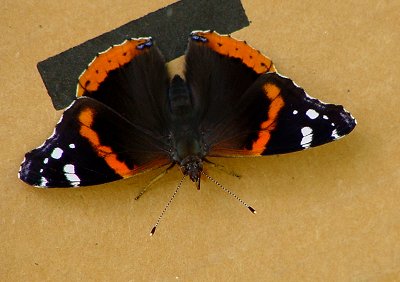
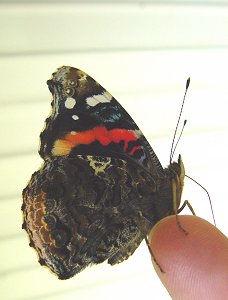
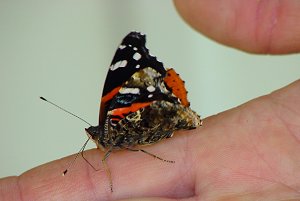
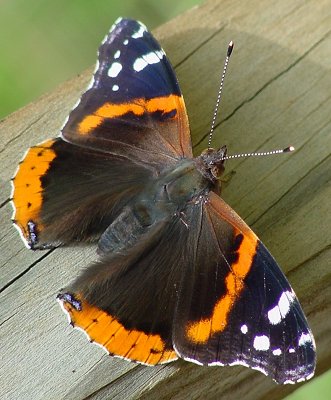
A Red Admiral butterfly (Vanessa atalanta) was attracted to some moisture on a cardboard box. I believe he was newly emerged, since he looked nearly perfect and wasn't too afraid of me.


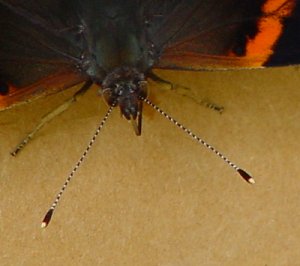
His close-up.


He seemed very thirsty.

I had an idea.

I dipped my finger into a puddle then snuck up slowly.


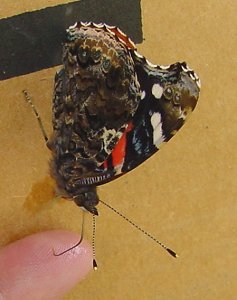
Ta-da!


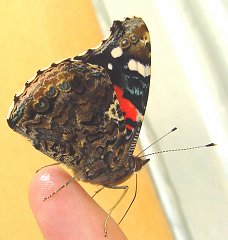
His feet were very sticky. This really tickles.


I taught my husband how to do it too.


The admiral sunbathed for a moment before he left.


Red Admirals are common and widespread: Guatemala north through Mexico and the United States to northern Canada; Hawaii, some Caribbean Islands, New Zealand, Europe, Northern Africa, the Middle East and Asia! I imagine that they do so well because the caterpillar's food plant is the nettle.

More info here, here, and here.

Thursday, November 18, 2010

Gunks Routes: Immaculate Conception/Son of Bitchy Virgin (5.6) & Bitchy Virgin (5.5)


(Photo: Heading up pitch 2 of Son of Bitchy Virgin (5.6))


Good judgment.


It is important to have good judgment when climbing. As a leader, I hope I have it. It is important to me to think that I have it. Thinking I have it is probably almost as important to my leading as actually having it.


As I've edged back into pushing my limits this year, I've tried to be cautious. But I know enthusiasm can at times threaten my good judgment. And I have a lot of enthusiasm.


My friend and longtime climbing partner Liz is having a baby in the fall. She has continued climbing (though not leading anything) during her pregnancy. She was with me on Apoplexy (5.9) earlier this year, for example. As her pregnancy has progressed she's gradually been forced to accept that she has to dial it back to easier climbing. But she hasn't given up without a fight. She gamely followed me up Birdland (5.8) in May even though she struggled with the cruxes of both pitches. On another occasion, climbing not with me, she had to prussik through the crux while following Modern Times (5.8+).


I was looking for partners while I was in New Paltz for the week before July 4 with my family, so I was excited Liz was thinking about joining us. I didn't want to put either of us in a dangerous situation given that she was now about halfway through her pregnancy. So I promised her that if she joined us at our summer house in New Paltz in early July, I wouldn't push her to do anything hard. We could focus on 5.6 and below, which we felt would be easy and casual for both of us.


My first idea was that we should do the Bitchy Virgin climbs. I had never done them. The original route, Bitchy Virgin, has two pitches of 5.5, and the successor Son of BV ups the ante slightly with one pitch of 5.5 and a second that is 5.6. In between is a variation single-pitch climb called Immaculate Conception (also 5.6) which ends at the Son of BV anchor. If we did them all we'd get 5 pitches done in this one little spot. Liz hadn't tried these climbs either so she agreed.


When we arrived at the base of the climbs, I thought Immaculate Conception looked like the most interesting line. A couple steep moves past some suspect flakes about 15-20 feet up seemed like the crux.


Once we racked up, I enjoyed it. The crux steep bit past the flakes leads over a bulge to easier climbing at a lower angle. The flakes are creaky but I don't think they're popping out any time soon. Once over the bulge there is a little bit of a runout to the belay ledge, but this runout is through territory much easier than 5.6. At the belay ledge there is a station made from slings threaded around a boulder, but I elected to build a gear anchor in the good cracks right above the ledge instead, so we could both comfortably stand on the ledge and belay with the anchor above our hands.


If our first pitch, Immaculate Conception, was nice, pitch two of Son of BV was really quite nice indeed. The climb goes straight up, trending a little left. It is nothing but good face climbing. Clean, steep and sustained, with good moves and good holds. I have seen reports of inadequate pro, but I thought the pro was just good enough. The horizontals appear every so often, and I even passed up an opportunity or two to place something a little off line to the left and the right. This is definitely not a pitch that you can sew up, however, and if 5.6 is your lead limit this climb might not be the best one for you. With that caveat aside, I would say Son of BV is yet another high quality 5.6 in the Gunks, worth the two stars Dick bestows upon it (when linked with Immaculate Conception) and further evidence that 5.6 is one of the great grades at the Gunks.


The rap tree on the GT Ledge at the top of Son of BV bears watching. This muti-forked tree has some live branches, and some that are dead or dying. It has seen better days. We went ahead and used it, because it didn't look like it would be that easy to get over to the much bigger and healthier-looking tree atop Bitchy Virgin. Pretty soon, unless the tree atop Son of BV recovers a bit, we may not have a choice. I have seen worse rap trees in the Gunks, but I think at another time in my climbing life I would have insisted we use a different station to get off the cliff. It may be that I have mellowed a bit when it comes to using these sketchy rap anchors, and I'm not sure this is a good thing. Perhaps we should not have used it.


Liz had no trouble following me up either of our first two 5.6 pitches, so I thought the two 5.5 pitches of Bitchy Virgin would be a breeze for her. It was getting hot out but neither of us were concerned. We didn't stop to take a break. Once we returned to the base I went right at pitch one of Bitchy Virgin.


The pitch climbs a corner at the back of a little gully that goes between the main cliff and the left side of the Mantle Block. I was surprised to find the Bitchy Virgin corner a little dirty. I didn't see much evidence of other climbers, either. This was in stark contrast to Immaculate Conception, the climb we'd just finished to the left, which had tons of chalk on it, even though all the nearby climbs were only recently reopened after the peregrine nesting that closes a portion of the cliff every year.


Is Bitchy Virgin unpopular? Dick Williams gives it a star. Perhaps it is the little scramble up the gully to the start that puts people off?


Whatever the reason, I think if people are taking a pass on Bitchy Virgin they are missing out. In my opinion it is good, and a bit stiff for 5.5. Nice moves go up the corner, using the crack at the back for pro and sometimes for upward progress. Eventually there is a somewhat awkward struggle past a tree (admittedly this part of the pitch isn't so great), after which you move a little further up the corner, almost to its top, before obvious holds take you on a fun, short traverse with good pro to the outside arete and around onto the main face, about 10 to 15 feet above the belay station for Immaculate Conception/Son of BV.


If I'm right that Bitchy Virgin isn't getting much traffic, I think that's an injustice. It is not a superclassic 5.5 like Horseman or Ursula, but I've done much worse one-star climbs in the Trapps. It is a totally worthwhile climb, and there aren't enough quality 5.5's out there for it to get so little attention, in my opinion.


Once I built us a belay, Liz had no trouble following the pitch. There was no sign of any problem. She came right up. Things were still going well.


So I set off on pitch two, having fun. It seemed a lot like pitch two of Son of BV, but easier. Clean steep climbing with good holds.


I was about twenty feet off the belay when Liz called up to me to say that she wasn't feeling well.


Uh oh.


I guessed that she was maybe feeling a little sick to her stomach.


I stopped and asked her a question. "Do you think you'll be able to finish this pitch?"


"No," she said. "I feel like I'm about to pass out!"


Crap. Not good.


Clearly we needed to get down. I immediately chastised myself for taking Liz up a multipitch climb. She hadn't had any fainting episodes on the rock before, but it suddenly seemed patently unwise to have her belaying me 100 feet off the ground halfway through her pregnancy, in the bright sunshine, away from the food and water. What a stupid thing to do. Both of us should have known better.


I stepped down to the last piece of gear I had placed and thought about our options. Option one: I could place another piece or two and build an anchor from which she could lower me to the belay. This meant that we'd be leaving pieces behind, which of course was a secondary consideration but still something to think about. Also, what if she passed out while lowering me? She was tied in, so she wouldn't go anywhere, but what about me? I'd be falling through space. She was belaying me with a Cinch, which should lock off if she were to let go, but still... this was not an acceptable option. I supposed I could build an anchor, attach myself to it, then pull up the rope and rap. But this seemed very time-consuming. There had to be a better way.


Quickly I came up with option two: I could just downclimb back to her. This immediately seemed like the better idea. She'd keep me on belay, I wouldn't leave any gear, and if she lost consciousness I'd still be on the rock, and not relying solely on her Cinch to catch me. The climbing had so far been through easy territory and I was confident downclimbing would be no problem.


I racked my brain for another option, but these were the best I could come up with.


So I downclimbed the twenty feet back to her, going as fast as I reasonably could and all the while talking to her to make sure she was still with me. It didn't take long, and it seemed with each passing second that it was less likely she'd actually faint. Nevertheless I was relieved to get back to the belay and clip in.


Once we were together I lowered her from the belay ledge to the ground, and then I rapped off. Even as I lowered her it seemed that the crisis had passed, but it still made sense to go find some shade, have some fluids, and rest a bit.


On the ground we ate and drank and Liz soon felt better; we even resumed some single-pitch climbing after we took a break.


As crises go this wasn't a big one. No one actually lost consciousness. No one was hurt.


But still one can learn from these experiences.


Obviously some of our decisions could have been better that day. We probably should have made more of an effort to stay in the shade, and to take things slow. And while maybe we didn't have to rule out multipitch climbing completely, at the very least we should have brought up some food and water with us on the cliff. I think we were lulled into a certain complacency by the fact that the climbing was easy and things were going smoothly.


So we maybe should have been more careful not to get into the situation in which we found ourselves. With that said, I think we behaved reasonably when the issue emerged. And I think the decision I made to downclimb was the right one, under the circumstances. The most conservative thing to do would have been to build an anchor, leave the gear, and rap to Liz. That would have allowed me to descend to her without requiring any belaying from her. If the climbing had been more difficult this likely would have been the only reasonable choice. But since the climbing was so easy I think my decision to downclimb instead was correct; it was the less complicated solution and quicker as well.


Good judgment? I guess I'll give myself a B. Poor planning, but a decent recovery.

Tuesday, November 16, 2010

Great Egret


For the past two days a Great Egret has been hanging around in the swampy lake behind our house. Last night and again this morning I watched as this beautiful bird walked around in the marsh and caught minnows from the lake. I wonder how long it will hang around?

Sunday, November 14, 2010

Mystic Art

This my son's stallion Darkan's Mystic Art. He is half Arabian, and half Saddlebred, and all beautiful.

Friday, November 12, 2010

Sherpas, some random thoughts and "Sherpa Adventure Gear"...

Photo courtesy of Mtn. of Travel web site

http://www.mountainsoftravelphotos.com/Makalu/Main.html

In the spring of 1977 John Roskelly and I left Spokane WA to attempt the West Pillarof Makalu with the first permission for a two person attempton a Nepalese 8K meter peak. Luckily for both of us in retrospect, John became severely ill on the walk in and our trip ended as a complete failure, still days from the mountain.


A 4 person Spokane team, againincluding John, returned to Makalu in 1980. John summitted alone on that trip butwith thesupport of ourfriends Jim States, Chris Kopczyski and Kim Momb. Theclimb was madewithout Sherpa support.


But John's and my short walk was a life changing event for me.


I had just started guiding in the NW a few years earlier and knew some of the the hazards even small peaks offer. The size, elevation and remoteness of the big Himalayan peaks was truly awe inspiring in 1977 and continue to be so now.


I was not comfortable in 1977 even paying porters to carry my gear into the mountains. I could not in good conscious ask anyone to climb a mountain with me simply for a salary. Even if that was likely the only salary available. I did notlike the economic realitiesof the relationship and did not want to be a part of it.


I have no clue how it is now but there was a pretty stark difference between the standard of living we enjoyedin the USA and the gear we would use compared to what the standard of living was in Nepal and the gear (which would be part of their salary)we would offer our porters or climbing Sherpas. I have not gone back to climb inNepal but even in 1977 I was uncomfortable asking anyone else to risk their life to come out and "play with me".


Enter Joe Puryear decades later. I admired Joe's Alaska climbs and we exchanged a few emails on routes he had done there. (there were few he hadn't) Joe was always gracious and gave freely of his time to complete strangers like myself.


Photo courtesy of Joe Puryear http://www.joepuryearimages.com/

You couldn't help but also notice on Joe's web site his climbing in Nepal and his obviousinvolvement in the Sherpa community.


http://climbnepal.blogspot.com/


I am sure there were othersprevioustoJoe's and David's tripsdoing something similar but they certainly inspired me by their actions. Theyseemed tobe involved in Nepal and the people not just just taking advantage of situation economically and getting to "climb on some one else's back".I liked what I saw and admired them for it.


If you look at Joe's web pages one of his sponsors isa company called Sherpa Adventure Gear.


http://www.sherpaadventuregear.com/index.php


To be honest until yesterday I thought Sherpa Adventure Gear was a small company, based in Nepal.Likely Kathmandu, and making the odd pieceof funky wool bits. Joe's trade mark hats for example :) I figured Joe was just supporting a local cause for the best of reasons. Nothing could have been fartherfrom the truthon the "funky wool bits". But I have no doubt Joe was "supporting a good cause for the best of reasons", just as Sherpa Adventure Gear was supporting Joe's avocation. By all accounts it wasa close and supportive relationship fromboth sides.


Here is the company line:


"Sherpa Adventure Gear was inspired by the many unsung Sherpa heroes of Everest. From the start, our goal has been to create outstanding outdoor clothing and gear you can depend on. But more than this, we want to show you a glimpse of the Sherpa culture and way of life. And at the same time support our Sherpa community back home. Whether you are looking for gear on your next adventure, or just want to learn more about the Sherpa people, you can discover all this in our website."


Tashi Sherpa

Founder and President


More here:

http://www.sherpaadventuregear.com/aboutus.php


Surprisingly Sherpa Adventure Gear is actually based in Renton Wa. Owned and staffed by Sherpa family members for the most part. But make no mistake this isn't a simple"mom and pop" operation. They have a national and international dealer network as well as several successful retail stores in Nepal. Sherpa Adventure Gear isserious player in active outdoor wear world wide. The majority of their products are sewn in Nepal with a smaller percentage in China at the moment. Mr. Tashi Sherpa and his immediate family are the driving force here and in Nepal.


As a small manufacture myself I have begun to look at what I make, how that effects others, the productsusefullife spanand how my products arerecycled.


It makes me more aware of what others are doing in their own communities and why.


The climbing community, especially the alpine climbing community is very small. And it hasn't changed much in the decadesI have been involved with it.. We are in fact a large family. Death is a fact in alpine climbing. Joe Puryear'sdeath last year effected many climbers, locally and Internationally. It will happen again...and again. It is part of our game.


This is a hard blog to write. Too many serious issues that most (including myself) would rather ignore. So I'll stop there.


I wouldn't have brought up Sherpa Adventure Gear here if I didn't think they were making some incredible products for hard alpine climbing, no matter what their politics were. But their politics stood out to me. I was introduced to the company yesterday and bought a couple of their pieces for my own use that I will review in the blog. Just wanted to give a heads up for a business and business model I admire in many ways.


"Namiste"

Thursday, November 11, 2010

Cycling Clothes for the Lycra-Averse

After reading yesterday's Minuteman Bikeway post, you may have been wondering: So what does a girl wear on a 22-mile ride on a fierce roadbike? I am glad you asked!

CYCLING CLOTHES:

I am not against athletic clothing when it comes to cycling as a sport. My problem is different, and I know that other women share it: My skin hates synthetic fibers, especially in the heat. Yes, the new synthetic materials are supposed to be feather-lite, super-wicking, fast-drying, ultra-comfort, and so on... But somehow my body just does not agree. If I attempt to wear anything synthetic, my skin goes haywire, and I immediately get this icky, sticky, "get-it-off-me!" feeling -- not to mention horrible rashes and irritations. Sadly, my skin is also sensitive to wool, even very thin, lightweight wool. I can wear wool as an outer layer, but not directly next to the skin.

As far as normally-available fibers go, this leaves me with cottons, linens and silks. Raw silk is the most comfortable of these, and has excellent natural wicking properties. Old-fashioned ski clothing used to be made of rough silk, but now these are super-expensive and hard to find. Cotton and linen are breathable, but not ideal for wicking. Still, if left with no other choice, it is possible to achieve wicking with cotton by wearing it in ultra-thin, gauze-like layers. Gauzy cotton clothing is currently in fashion, and I have taken full advantage of summer sales. The dress pictured in these photos is a good example.

This mini-dress consists of two layers of very thin, gauze-like cotton. I bought it in Europe, but I have seen many like it available in the US, from the Gap, Old Navy, H&M, and many other stores. The loose baby-doll style with large arm openings around the straps provides superb breatheability. Worn over a cotton sports-bra and cotton leggings (the leggings function as "bloomers" -- i.e. underwear and leggings in one), this sort of dress allows the breeze to circulate under the wide hem, through the arm openings, and in between the two gauzy layers, providing amazing ventilation. I had zero sweat stains during the 22 mile ride. It is crucial that this kind of dress be short and wide enough, so as not to get caught on the saddle when mounting and dismounting. Notice also the enormous pockets -- handy for storing hair elastics, mobile phone and camera. The leggings + sportsbra + gauze dress outfit, in several colour variants, is basically my cycling kit for longer, sporty rides.

CYCLING SHOES

Simple shoes -- the best bike shoes! I saw a heap of these on clearance at the UGG/Teva Outlet in Wrentham the other day. I remembered reading about these on BikeSkirt some time ago, and decided to give them a try. I wanted something athletic, but summery, that could be worn without socks. The Simples are great, because they have a thick, hard, shock absorbent sole that is extremely effective for pushing down on pedals. The natural canvas material makes them breathable and light in even the hottest weather, but the enclosed rubber toe is great for those times when your toe hits the pedal -- which can hurt like hell on a roadbike in open-toed sandals. I have worn Keds, Converse and Vans, and the Simples work better for me as bike shoes than either of those.

Cycling clothing for the lycra-averse (and the athletic-gear-averse) need not be impractical. I was completely comfortable cycling for 22 miles+ in this outfit and shoes, and could easily have gone for longer. At the same time, we were able to go straight from the trails to one of our favourite restaurants for a dinner out. Of course, everyone's experience is different, and what is comfortable for one person may not be for another. Experimentation and listening to your own needs is key.

Tuesday, November 9, 2010

Ida Joslin Dressler Lewis (1863-1937)

Before posting more letters from Ida, I thought perhaps a little background information might be helpful.

Ida Blanch Joslin, the 11th child of Lysander and Lydia Robison Joslin, was born on July 11, 1863 in Whitley County, Indiana. She was three years old when the family moved to Jefferson County, Iowa. In August 1868 they returned to Whitley County then in 1877, Lysander and Lydia moved to Barton County, Kansas taking with them their four youngest children: 17 year old Andrew; Ida, 13; Della, 10; and Elmus, age 8.

Now, a bit of a mystery develops. Among those listed in the household of Lysander in the 1880 federal census for Cheyenne township, Barton County, Kansas was a one year old son, Charles Joslin. It is not likely that Charles is actually a son of Lysander and Lydia as Lydia would have been about 54 years old when Charles was born. It is more likely that Charles was a son of their daughter Ida, who would have been about 15 years old when he was born. Charles lived with Lysander and Lydia. He is listed in the 1885 and 1895 Kansas state census records with them. There is a transcription of "Father's Bible" which lists all of the children and their dates of birth. Charles is not among those listed. We (Joslin researchers) had not had any success in locating Charles until recently.

In December I decided to check the World War I Draft Registration Cards on ancestry.com and found the record for Charley Sylvester Joslin. Dated September 12, 1918, his permanent home address was given as the National Military Home in Kansas. He was 39 years old, born March 4th 1879. But what was most interesting was the name of his nearest relative: Mrs. S. T. Lewis. The name of Ida's second husband was Sam Lewis. In the 1930 census for the National Military Home, Delaware Township, Leavenworth, Kansas (page 136) is a Charley S. Joslin, male, white, 51, single, born Kansas, parents born Indiana, no occupation, veteran of Sp [Spanish-American War].

Another researcher then found a record of burial for Charley in the Leavenworth National Cemetery, he died April 25, 1934. Next step will be to see if we can get a copy of his death record and/or obituary. I also found a military pension card for a Charley S. Joslin. The card shows he served in Co. "I" 17 Reg't U.S. Inf., Enlisted Sept. 27, 1902, Discharged Sept. 26, 1905. The dates of service don't coincide with the Spanish-American War so I'm not sure if it is worth spending $75 for a copy of his record to satisfy my curiosity to find out if this is "our" Charley.

Okay, now, back to Ida. On July 20, 1882 Ida was married to John G. Dressler at Oden, Barton County, Kansas. John was about 15 years older than Ida. In December 1883 their daughter Elnora was born, followed on February 24, 1885 by the birth of their son, Joseph. The 1900 census shows John Dressler living with his second wife. They had been married 3 years, so we know that John and Ida were divorced before 1897. Joseph was living with his father in Russell County, Kansas and Elnora was with her mother living in a boarding house on McGee Street in Kansas City, Missouri.

Ida has not been located in the 1910 census yet. But we know from the draft registration card of Charles Joslin that she was married to Sam Lewis prior to September 1918. In 1920, Sam and Ida were living on East 9th Street Kansas City, Missouri and in 1930 they were living on Wabash Street, Kansas City, Missouri.

We haven't discovered when Elnora Dressler died. She has a marker with no dates next to that of her mother and Sam Lewis in Mt. Washington Cemetery, Kansas City.

The only clue we had regarding the whereabouts of Joseph Dressler was in Ida's obituary which stated that a son, Joseph, lived in New Mexico. Once the census indexes became available online it was a relatively simple task to locate him. To make a long story short, in September .., I made contact with a grandson of Joseph Dressler. Joe had married Belva Roe about 1904 in Kansas and had three children (Arthur born 1905, Lola born 1907, and Chester born 1910) before moving to Torrance County, New Mexico sometime between 1910 and 1920. Joe didn't have any contact with his mother until after his father passed away. He did visit her several times and took care of settling her estate.

I sent the information that I had on John and Ida to Joseph's grandson along with some of the information on Lysander and Lydia. I also included some blank family group sheets, hoping he'd fill them out with the missing information, but alas, I never heard from him and having gotten off onto other things, never followed up.

Ida Joslin Dressler Lewis passed away on March 4, 1937 in Kansas City "of pneumonia which followed influenza. Mrs. Lewis and her husband were stricken with illness some weeks ago and were taken to the hospital. Mr. Lewis passed away four weeks ago. Mrs. Lewis died of shock when told of her husband's death last Friday by a friend who visited her at the hospital." She was 73 years old.

The letters from Ida being posted were written to her sister, Malissa Joslin Brubaker Bower, who passed away at the age of 88 on September 30, 1937 - just six months after Ida's death. The other two sisters mentioned in the letters were Roxie Parkison, who died March 5, 1941 aged 87 in Ottawa County, Oklahoma and Della Quillen who died February 7, 1943 in Darlington County, South Carolina, age 76.


Ida Blanch Joslin Dressler Lewis and her husband Sam Lewis


Caption on back of the photo:
back yard under the Peach Trees the building is out in the ally
an old Garage of neighbor it spoiles the Picture he is an old ___

Upside down text was written by Malissa:
Sister Ida Lewis & hubby Sam Lewis Kansas City MO

Monday, November 8, 2010

Step-Throughs: an Advantage in Traffic?

There was aninteresting postonecoveloyesterday, where the author compared how he uses his three transportation bikes: aRivendellSam Hillborne, aSurlyLong Haul Trucker, and aCiviaLoring. All three bicycles are set up with upright handlebars and decent load carrying capacity, but the Civia differs from the other two in that it has a fairly low stepover. And according to the author, the combination of its "upright riding position, step-through frame, and internal gear hub make[s] the Loring exceptionally confidence inspiring for riding slowly when in close proximity to pedestrians and automobile traffic." Initially, I read past that sentence with the kind of matter-of-fact acceptance that goes with processing what you already consider to be a given. Butthen later I mentally "rewound" and thought "Wait a minute, he is saying that he finds it more comfortable to ride a step-through in traffic than a diamond frame - Is this a generally accepted notion?"

I used to think the reason I prefer step-throughs for transportation, is that I often wear skirts. But having read the ecovelo post, I realise that even when wearing trousers I feel better on a step-through in traffic. And, assuming that Alan of ecovelo mostly wears trousers, for him there must be other factors involved as well. Maybe for me it's the promise of the easy "hop off sideways" dismount should I need to bail, that makes me feel more secure. But to tell the truth, I am not sure what it is, and whether my preference is entirely logical.


All factors remaining equal (upright handlebars, ride quality, load capacity), what, if anything, would make a step-through bike an advantage in traffic?

Sunday, November 7, 2010

Nomic Hammers?


Blatant commercial spiel here..so be warned.

This is something I have been doing commercially but generally under the radar for the last 3 years all the while trying to get Petzl to do it themselves. The new Nomic will offer a hammer as an option.

I'll also be making this hammer as a retro fit for all the newest tools and the new picks this coming winter. But no reason to sell your old Nomic. Most of the newest features can be upgraded into your current Nomic including the better umbilical attachment point and hammer.

First experience with the new lower grip pommel is it will also retro fit with a little effort.

This hammer is lighter and better balanced than Petzl's new hammer for the Nomic. I cut new factory picks to fit my hammer. Spare picks for these hammers can also be easily made from the older style (pre winter of '10/'11) Quark picks and a few minutes on a grinder. Nomic pick weights are 62grams. The CT hammer is 34grams. The Petzl Nomic hammer is 65g.

Friday, November 5, 2010

Pea Island National Wildlife Refuge

I've been counting down the days for something exciting-my dear friend Barb and her husband John coming to camp with us. We met them at the Pea Island Wildlife Refuge and wandered around for a short time. A very short time compared to how long we probably both would have stayed because the mosquitoes were out in killer force even with bug spray on. It is a beautiful refuge from what we did see and we saw a few birds while there.

Refuge Facts

  • Established: May 17, 1937.


  • Size: 5,834 acres (land), 25,700 acres (Proclamation Boundary Waters).


  • Located on the north end of Hatteras Island, a coastal barrier island and part of a chain of islands known as the Outer Banks.


  • Approximately 13 miles long (north to south) and ranges from a quarter mile to 1 mile wide (from east to west).


  • Location: 10 miles south of Nags Head, North Carolina on NC 12.


  • Administered by Alligator River National Wildlife Refuge as a part of complex; Alligator River Manager supervises the Mackay Island, Currituck, and Pocosin Lakes National Wildlife Refuge Managers.


  • The Comprehensive Conservation Management Plan for Pea Island National Wildlife Refuge is complete.

Natural History


  • Area was historically used for market waterfowl hunting, commercial fishing, farming, and

    livestock operations.


  • Refuge is comprised of ocean beach, dunes, upland, fresh and brackish water ponds, salt flats, and salt marsh.

  • Bird list boasts more than 365 species; wildlife list has 25 species of mammals, 24 species of reptiles, and 5 species (low number due to salt environment) of amphibians.


  • Concentrations of ducks, geese, swans, wading birds, shore birds, raptors, neotropical migrants are seasonally abundant on refuge.


  • Refuge has 1,000 acres of manageable waterfowl impoundments.


  • Several shorebird nesting areas and wading bird rookeries are located on the refuge.


  • Endangered and threatened species include: peregrine falcons, loggerhead sea turtles, and piping plovers.

Refuge Objectives

  • Provide nesting, resting, and wintering habitat for migratory birds, including the greater snow geese and other migratory waterfowl, shorebirds, wading birds, raptors, and neotropical migrants.


  • Provide habitat and protection for endangered and threatened species.


  • Provide opportunities for public enjoyment of wildlife and wildlands resources. Public use programs focus on interpretation, environmental education, wildlife observation, wildlife photography, and fishing.

Thursday, November 4, 2010

Yorktown Victory Monument

Today we headed over to Yorktown. While driving around, we came across this monument. We hadn't even heard of this monument before, so we felt quite lucky that we did happen upon it. It was just gorgeous!

Some fun facts:

The concluding battle of the Revolutionary War ended October 19, 1781 in Yorktown, Virginia. General Cornwallis and his 7,157 men surrendered to General Washington. To commemorate the important Allied Victory over the British, the Continental Congress on October 29, 1781, authorized the Yorktown Victory Monument. Construction began a century later with completion in 1884.

Lady Victory, a younger sister to the Statue of Liberty, exquisitely tops a slender pedestal of Maine granite. In 1956, replacement of the original figure of liberty, damaged by lightening, took place.

The shaft is 84 feet high and Liberty is 14 feet high.

This is a monument that we are sure to remember!

Living the life in Historical Virginia!

Monday, November 1, 2010

Davis Mountains Interlude

Upon leaving Big Bend National Park on the morning of March 3rd, my “plan” was to go north to the Guadalupe Mountains National Park, which is in northwest Texas and bordering New Mexico. One of the other campers suggested that I stop at Davis Mountains State Park, which was on the way to Guadalupe.

The 100+ mile drive from Big Bend was uneventful. Which is good. The largest town along the way was Alpine. They had a McDonalds and it had Wifi, which is also good. I stopped for lunch, stayed two hours and was able to check email as well as get several posts uploaded and scheduled. The next town down the road was Fort Davis.

A few miles north of Fort Davis is Davis Mountains State Park. The campground is nestled inside a canyon. The sites are quite nice with lots of trees providing shade, which in the summer would be a blessing. The weather was beautiful during the day with temperatures in the 60s, mostly blue skies and sunshine. After the sun went down, the chill set in and the temperature dropped into the low 30s. Quite similar to the weather at Big Bend, but at least it didn't snow!

A section of the trail leading to the top of the “hill” on the north side of the campground.

Looking to the north across the Davis Mountains.

Looking to the west, from the top of the hill. I don't know the significance of the pile of rocks, if any, but found it amusing that it mimicked the peak in the background.

Looking south. A section of the campground is tucked away beneath the row of trees in the center.

The trail follows the top to the west end then takes you down into the canyon where the Lodge is located. This is the view looking east from about half way down. The row of trees in the center is where the campground is located. You can see a portion of the “Skyline Drive” built by the CCC. As well as providing some magnificent views there are also several more trails up on top of that peak.

My stop in the Davis Mountains was a very pleasant interlude that lasted six days! The fact that the town of Fort Davis was ten minutes away and the Jeff Davis County Library had an excellent, secure, wifi connection, made it even more pleasant. Sometimes you've gotta have some downtime! I was able to get caught up with email, wrote and scheduled blog posts for nearly a week, even read some blogs, and checked in on Facebook! Oh, and I got my taxes filed too.

To top it off, the library staff was very helpful and courteous. The building wasn't much to look at. And the old wooden floors kinda creaked. But there was a steady flow of people in and out and when school let out for the day it was abuzz with kids. I can only wish for more libraries like this one. The only “downside” was that the library was closed on Saturday and Sunday. But that's okay. I'm just glad it was there!

The Manatees of Blue Spring

Sunday, February 3rd - - Located north of Orlando, Florida along the St. Johns River, Blue Spring State Park is the winter home of a small population of West Indian Manatees. Perhaps a dozen or so were within the viewing area provided by the park on the day I visited. For more information on the Manatees, see the Save the Manatee website.


The shallow, crystal-clear water is ideal for viewing the Manatees.


A little one coming up for air.


A group of four youngsters heading upstream.


This one was feeding on the algae at the bottom of the stairs. It was there for quite a while and it was one of the larger manatees in the area that day.


Another large one meandering upstream. They seemed to like to hang out beneath the viewing platform.


A more mature manatee.


A psychedelic version, compliments of a little wind and some sunshine.


There was a lot of pushing going on around a tree that had fallen into the stream.


The green leaves must have been the best tasting...