Monday, June 28, 2010

The Petzl ICE pick issue


The quotes listed below were found from a quick Internet search on the current Petzl ICE pick. It seems silly to me that Petzl had a amazinglyly well recieved pick, the Cascade, that they have now discontinued for the Nomic. Even more so now that the Cascade pick would fit all three tools, Nomic, Quark and Ergo. When your customers start using another brand's picks I suspect you have an issue that needs to be resolved, sooner rather than later.


None of this is to argue the newest picks are bad, just that some prefer the previous design.


Here is a short discussion on how to modify the newest picks for better ice performance by duplicating the older Cascade pick.


http://coldthistle.blogspot.com//10/petzl-picks-again.html


Quotes by various Internet authors on the same subject:

"I've heard rumors that Cassin's X-All picks can be modified to fit onto Nomic or Quark. Any truth to this? I'm a little frustrated with the new Petzl Ice picks (detuning isn't working out that great)."


"The new Nomic Ice pick is hard to clean, but filing it down to closely match the profile of the old Cascade pick worked great for me."


"there are a few things I noticed with the new Ice picks. Durability, cleaning, and ice displacement. Maybe this season is a bad example because how thinner the routes are, but I noticed my Ice picks getting chewed up and worn down significantly faster. I've filed the picks three times already, when I normally do three filings for the entire season on my old Cascade picks. Cleaning on the new Ice picks is harder than before, this is well know."


"When I compare the picks to old style, they are completely different. It has beenpointed out that I can modify the new Ice picks, but I haven't had the chance to test that out."


"I have a big potential issue with the new Nomic Ice pick though. At the gym where I train, it is literally impossible to get a stick in the Iceholdz(TM) on the mildly overhung system board. With adjustments to swing and hand position, I have been able to get good sticks with both Cobras and the old style Vipers. I'm guessing the first tooth is too steep (which is one of the things causing the cleaning problem with Laser picks) so I worry what they'll be like on real ice."


"The new Ice picks, while better than the old Astros, are definitely not as good as the old cascades from my experience using both of them last season on a pair of new Quarks and old Nomics. I'm pretty sure the reason is the same already mentioned: the angle of the first tooth."


In North America if you have a similar thought you can direct an email toPetzlAmerica at info@petzl.com

It is a topic Petzlwants to hear from you on. So the emails aren't going to a round file as some might expect.


I don't have a Petzl France email but if you are outside North America I suspectyour concerns will be relayed to Petzl France as well.


Friday, June 25, 2010

D2R Boogie: a Miniature Non-Folder

When I saw this bicycle at Harris Cyclery, it immediately caught my eye - in a "what onearth is that?..." kind of way. It appeared to be a miniature "swan frame" bike with extremely modern components, small wheels and fat tires. And for some reason, it was calling out for me to ride it. The bicycle is not yet for sale, but was apparently a sample the dealer left behind. I believe it will be available in April . This creation is called "Boogie" and it is made by the company Decide 2 Ride (D2R), which has hitherto been specialising in panniers and other bicycle accessories.


What I initially found appealing about the Boogie, was the overall elegance of its design. Despite the eye-catching swan-frame, it is an un-appologetically modern bike - with techie components, industrial-style accessories, a unicrown fork, and visible welding marks on the frame's joints. But?.. I have to say, they did a good job incorporating it all into the overall design, so that these elements actually look like they "belong" on this particular bike.Everything is in harmony; everything fits together just right. The bike does not try to look "faux vintage" - and that works in its favour. It comes across as being unique and intentional. The only other modern bicycle design I have seen thus far that achieves the same equilibrium is the KHS Green, which I also like very much. And to me, this just confirms that even if you give a good designer a small budget, and limit them to modern production techniques and components, they can still come up with something that looks visually pleasing - not only in carefully lit catalog photos, but in person, up close.


The Boogie is a miniature, small wheeled non-folder. The reasoning behind creating it, was the premise that the majority of those who buy folding bikes don't actually fold and unfold them. Rather, they choose the bikes for their small unfolded size and light weight - factors especially relevant for city dwellers who must maneuver their bike through cramped spaces and drag it up staircases. In my experience, this is true of most women(but not men) I know who own folding bikes, and I suspect the Boogie will be more appealing to women than to men.


The lightweight frame of the Boogie is aluminum (I had previously received conflicting information about the frame material, but this has now been confirmed by the manufacturer). The fork is cro-moly steel either way. The bicycle is adjustable for a wide range of heights, and it comes in two sizes: for those 6 ft and below, and for those over 6 ft. The bike pictured here is the smaller size. Both saddle and handlebar height can be adjusted to fit riders of different proportions.


The wheels on the Boogie are 20", fitted with 2.125" wide tires. The model I tried comes with full fenders and a large rear rack as standard features, as well as with derailleur gearing - though single-speed and 8-speed hub versions are also available.


Kickstand is also standard - and it was a very sturdy one as far as kickstands go.


Of all the features on the Boogie, there are only two I don't like and would change if it were my bike: The padded synthetic saddle would have to go, and I would replace the handlebars with an inexpensive swept-back "North Roads" style version - simply because I can't comfortably use straight handlebars. Those who are more tolerant of stright bars may not care. Either way, the handlebar change can probably be made for $20 or so, so not a big deal. I would definitely keep all the components black, as to me that is part of the bike's charm.


This is what the bicycle looks like next to my 5'7" frame. As you can see, the step-over area is very low - just above ankle-height, which make it easy to mount and dismount even if wearing a long skirt.


I was not sure how a bicycle like this would handle, but it felt comfortable from the get-go: Easy to get started, stable, intuitive, maneuverable.


I test rode the Boogie briefly on the roads in traffic (actual test ride not pictured), trying to determine how the small wheels and fat tires would feel over pot-holes, and also whether the bicycle would accelerate well. All was good in these respects. This is not an aggressive bicycle; it is a comfortable one. But it certainly provides enough power to be used as urban transportation. Switching gears was easy using the thumb-shifters mounted onto the handlebars. The brakes were powerful. One confession I have to make, is that I felt more comfortable with this bicycle than I did with the Brompton I test-rode earlier. I am not sure why, so cannot really elaborate. Perhaps I need to ride the Bromptonagain to get a better idea. And of course, the quality and the functionality of the bicycles are different: The Brompton is undoubtedly better made and it is a folder, while the Boogie is in a lower budget category and does not have the folding capacity - so in comparing how I felt on them, I am speaking solely of the test-ride experience.


The Co-Habitant tried the Boogie as well, and found it to be "fun" - though he is baffled as to why I like it so much. He thought it was a cool bike, but not that big of a deal. So - to each their own.


The version of the Boogie I tried (derailleur, fenders, rack) is supposed to retail at around $750. I believe that the single speed version will be in the $400s and the 8-speed hub version in the $900s. Given those price points, I would probably go for either the single speed or the derailleur version - though ideally I would have liked a simple 3-speed hub. Lighting is not included, so that would be an additional expense. Although the Boogie will be available in other colours (white and sage), I think that black is the only colour that really works on this bicycle: Judging by the online pictures, the welding marks look much more prominent on the lighter-coloured bikes, detracting considerably from the elegance of the design I praised here. The striking harmony between the frame colour, component colour and accessory colour is also possible only with the black version.


If you are looking for a simple city bicycle on a budget, this is one of the few in the lower-priced category I actually like. The proportions and small wheels are not for everyone, but I find the overall design and ride quality appealing.

Christmas Star


Wednesday, June 23, 2010

Coaster Brakes: Yay or Nay?

I love coster brakes on upright city bicycles and for me this feature is pretty much a must. But I am also aware that not everyone feels the same. So when I am asked whether I think a coaster brake is "better", I can respond only by outlining the pros and cons, as I see them. In short, here is my take on the coaster brake:


What is a coaster brake?

A coaster brake is a rear brake on a bicycle that is activated by pedaling backwards. If you want to slow down, simply start to push the pedals backward instead of forward with your feet. The harder you push back, the more braking power is applied. This type of brake is common in upright city bicycles, and it is usually (but not always) supplemented with a front hand-operated brake. The coaster brake is internal and lives in the hub of the rear wheel, rarely requiring maintenance or adjustments.


Why I love coaster brakes:

. I find that coaster brakes deliver softer (no sudden jolts), smoother, and more consistent stopping power in city traffic

. I like to have one hand free in traffic, so that I can signal while braking

. I find it easier to modulate coaster brakes at finer increments without totally losing momentum

. I have problems with the nerves in my hands, and find it painful to use hand-operated brake levers frequently (like in stop-and-go traffic)

. I find coaster brakes intuitive and stress-free to use: it makes sense to both accelerate and slow down with my feet

. I like it that coaster brakes require virtually zero maintenance or adjustments


Why some dislike coaster brakes:

. They find the act of backpedaling confusing or counterintuitive

. They find it inconvenient that with a coaster brake, you cannot bring the pedal back into starting position in the same way as on a non-coaster brake bike

. They feel that a coaster brake does not provide sufficiently strong braking power

. They lack the leg strength to activate the coaster brake (or have problems with their legs or knees that prevent them from doing so)


I should also add that coaster brakes make sense only on upright city bicycles. Using them on a roadbike would be tricky, because of the speed and the leaned-over position (though I do know of some who have tried, just for fun).


If you have never tried a coaster brake, there is no way to know whether it's right for you until you test ride a bicycle fitted with one. When I tell anti-coasterbrakites that I love coaster brakes, their response is usually "Oh, but I bet that's because you got used to riding a bike like that when you were a kid." Not true: The first time I tried a coaster brake bicycle was in April . It was love at first backpedal!


How do you feel about coaster brakes, and why? I am sure all feedback will be useful to those wondering about this braking system.

Monday, June 21, 2010

Phend-Fisher Family Reunion Ledger (1942-1943)

The 33d Annual reunion of the Phend family was held at Nappanee Community Park Aug 30, 1942 with 32 in attendance. Also two Visitors Mr. & Mrs. W. O. Yarian of Toledo Ohio.

A Very good dinner was served which was enjoyed very much by all present.

Meeting called to order by president Henry Phend.

Motion made & 2d that Henry Phend remain as President
Fred Ernest V. President
Sec & Treasurer Virginia Phend, Larwill Ind

Balance of $1.40 from last year
Paid .25 Postage
leaving Bal $1.15

Motion Made & 2d that reunion be held at the same time & Same Place. Last Sun in Aug. Motion carried.

[page 2]
Collection today 2.85
Bal last year 1.15
Total 4.00
Paid for Pavillion 2.50
Bal 1.50

Births
To Josephene Poyser, daughter Sharon Rose

Deaths

Marriages - 1942
Betty Phend to LaMarr Stouder
Dean Ernest to Doris Mansfield
Elizabeth Phend to Charles Young
Mabel Phend to Harry Swiehart
Kohl Miller to [Dorothy Anderson]

[page 3 - marriages, continued]
Anna Mae [Thornton] & Martin Miller
Richard Thornton & Janice Roper

Minutes read, approved & signed.
F A Wehrly sec & Treas.


==+==+==+==+==+==+==

Phend-Fisher Family Reunion Ledger (1943)

1943. No Reunion.

Balance last year $1.50
Cards .08
Bal. 1.42

==+==+==+==+==+==+==

The Phend-Fisher families gathered for a reunion in Northern Indiana almost annually from 1909 until 1943. The events of the day were recorded in an old ledger book. Spelling has been retained as it was in the original though some punctuation and paragraph breaks have been added. To view all articles in this series click on the "Phend-Fisher Reunion Ledger" label at the bottom of this post. This is the last post in this series.

It would be 9 more years before the Phend Family Reunions resumed. On August 28, 1952 a family gathering was held in honor of Henry and Susie (Yarian) Phend on the occasion of their 60th wedding anniversary and the gatherings have continued annually since. You can read more about these reunions in my post titled The first Saturday in August.

Sunday, June 20, 2010

Kilian again!


Photo of Mont Blanc courtesy bigstockphoto.com


A few of us took note of this when it happened back in Sept. but I was unable to put it into context here. His run on the Grand is likely better understoof by the NA locals.


More here on that one:


http://outerlocal.com/hiking/the-grand-teton-a-runners-peak-outpost


This should help with the Innominata climb.


"Kilian Jornet, 25, one of the world's great endurance runners, has speed soloed
the long, technical and exposed Innominata on the Italian side of Mont
Blanc in a scant 6:17. The time is amazing on many levels. While technically the
climb is easier than the north faces of the Eiger or the Matterhorn, the scale
is much greater and the objective dangers are higher. Jornet, who is not even
known as a climber, started from the church in Courmayeur at roughly 3,300 feet
and ran the 12,000 feet to the summit of Mont Blanc, then ran over 12,000 feet
down the French side arriving at the church in Chamonix in a total time of 8:43."


There is more and worth a look.


""Can you imagine what I could do if I had the physique of Kilian?" Steck told
Rock and Ice."


http://www.rockandice.com/news/2250-kilian-jornet-takes-speed-soloing-to-next-level


More on the Grand climb:


http://outerlocal.com/hiking/the-grand-teton-a-runners-peak-outpost


Running Grand Teton trailer from Teton Movie on Vimeo.


Saturday, June 19, 2010

Snowy Again

Storms have dropped fresh snow on the mountain over the past few days. Be sure to check the forecast before you leave home and prepare accordingly. The skiing is improving!

Check out new conditions updates on the Disappointment Clever and Muir Snowfield.

Monday, June 14, 2010

Caterpillar's of the week


caterpillar's of the week. A Mullein moth caterpillar with its striking black and yellow markings.How I found it I don't know and after a flick through my book with several onlookers it was I come to the conclusion it is called The Drinker.

Sunday, June 13, 2010

A (Pashley) Penny for Your Thoughts

Pashley Penny
The Pashley Pennyis the companion model to the Parabike I wrote about earlier. This unusual bicycle looks vaguely old-fashioned, but unlike the Parabike it is not based on a specific vintage design. Part cruiser, part mixte and part mountain bike, its uniqueness is enhanced by eccentricities such as the split curved downtubes. The Penny defies classification, and this seems to be how the manufacturer intends it - explaining that the bike "provides the perfect excuse to experience more rural rides."


Pashley Parabike & Penny
While the Parabike's aesthetic is defined by the continuous curvature of its top set of twin stays, from head tube to rear dropouts, in the Penny the curve is interrupted and inverted. This difference is so visually dominant that it overshadows the structural similarities between the two bikes. The Penny also lacks the military/historical somberness of the Parabike, coming across as more light-hearted.


Pashley Penny

Made of cro-moly steel, the Penny is handbrazed and powdercoated in Stratford-upon-Avon in England, like all Pashley bicycles. It is fairly lightweight for its category of bikes, coming in at under 30lb.


Pashley Penny
Like the Parabike, the Penny is built for 26" wheels and fitted with 26 x 1.75" Schwalbe Marathon tires.Colour-matched fenders and chainguard are included.


Pashley Penny

Components include a 5-speed Sturmey Archer hub, hand-operated hub brakes front and rear, a Brooks B67S saddle, a Stronglight crankset, non-slip platform pedals, rubbery "faux cork" grips, and a large bell.Unlike the Parabike, the Penny is set up with straight, rather than swept back, handlebars.


Pashley Penny

Standing over the bicycle for the first time, I was overwhelmed by all the flowy slender tubes; it was a bit like standing over a swaying rope bridge. Not that the tubes sway. It's the form and the repetition that give that impression of movement. A unique design to be sure.


Pashley Penny

One thing I had wondered about when seeing pictures of the Penny, was whether the stepover was low enough to be practical. Unlike a traditional mixte, the twin parallel stays here don't extend all the way down to the rear dropouts, but connect to the upper seat stays - which places them rather high. However, this is compensated for by their downward sweep. When mounting the bike, the stepover height resembles that of a typical mixte.


Pashley Penny

Riding the Penny, my first impression was that it felt too small for me (I am just under 5'7"). My test riding partner agreed that the Penny's "cockpit," even with the straight handlebars, felt smaller than the Parabike's. Later I looked up the sizes of the two bikes and was surprised to see them described as the same: 19" (48cm). Of course this measurement refers to the seat tube length, and it's possible that the Penny's virtual top tube is shorter than the Parabike's. Regrettably, I did not measure the bikes and have not been able to source geometry charts. But the good news is that the Penny will work well for smaller riders and those with shorter torsos.


Putting the fit issue aside, the ride quality and handling of the Penny felt very similar to that of the Parabike, which I liked very much: maneuverable, extremely cushy over bumps, mountain-bikey but with a relaxed cruiserish element to it.These are entirely different bikes from Pashley's Roadster and Princess line.Personally, I prefer the way the Penny and Parabike ride to the classic Princess. Of course the looks are a matter of taste.


Pashley Penny

One advantage of the Penny over the Parabike, is that - to my eye at least - its aesthetics do not conflict with a standard rear rack. So turning it into a practical city bike would be fairly simple. Unfortunately, dynamo lighting is not included. Also not included are the waterbottle cage mounts that I noticed on the Parabike. Step-through frame designs often do not lend themselves to this, and it's too bad. Finally, I am not sure why the Penny was set up with straight handlebars rather than swept-back bars - I suspect that much of this bike's target market would find the the latter more comfortable.


Pashley Penny
In their description of the Penny, Pashley suggests that this bike is meant to move effortlessly between town and country. I can see that. Provided that it's a fairly flat area, this bike could feel equally enjoyable to ride through meadows and forests, on cobblestones and on busy city streets, for shorter and longer distances. It is a nice combination of comfortable, maneuverable, and intuitive to handle. The durable powdercoat and the enclosed brakes and gears allow outdoor storage and make this bike a good choice for winter and inclement weather conditions. If the unique look of the Penny appeals to you, the bike is worth taking seriously.


Pashley Penny

The Pashley Penny is available in "willow green" (shown here) or "dusk blue" - a dusty indigo. Current retail price is $1,195. Both the Parabike and Penny are available for test rides at Harris Cyclery in West Newton, MA. Many thanks to them for setting up these demo bikes.

Friday, June 11, 2010

Horse Won't Herd

Tuffee was trying to herd Nita. Now she looks at me as if to ask "What do I do now? She won't herd."
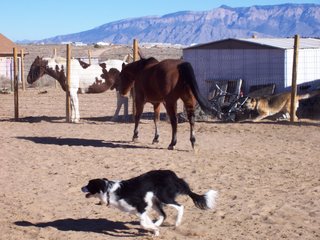
Sunday, June 6, 2010

Me & Dogs


Here is a photo of me, Tuffee, and Codee taking a break while stacking hay for horses. And another shot of Tuffee, and Codee as they think they are herding my bay mare, Nita, and the paint, Sundance.

Taking the Lane with Elly Blue


Following the online presence of Portland-based bike activist Elly Blueover the past year, her perspective seemed so different from mine that it was as if she wrote from another planet. Critical Mass, relentless activism, political organising, and the accompanying stylistic elements - It's not my world and it's not my way of thinking. But when faced with swathes of difference, it often happens that the littlest suggestions of a common thread begin to stand out and attain significance. For me, the first of these was Elly's post My So-Called Out of Control Life- a non-bike-related essay thatexpressed my own unease with the hyper-confessional style of writing so popular with females of our generation. It was odd to read my own thoughts echoed in this piece, and to recognise our shared cultural references.


Shortly thereafter another common thread emerged: We both decided to quit facebook, independently and at around the same time. But what's more, is that right before I quit I noticed with amazement that Elly Blue appeared to be a "friend" of one of my real-world friends. How could they know each other? My very good friend L. has nothing to do with cycling, activism, or Portland. She does not read bicycle blogs (and, like most of my friends, has no idea that Lovely Bicycle exists). So how were they connected? I didn't feel comfortable asking at the time, but found myself paying closer attention to Elly Blue as a result of this discovery. When she announced the publication of Taking the Lane Volume 5: "Our Bodies Our Bikes," I bought one with intent to review it. She then included a couple of other volumes, so that I could get a better feel for the zine as a whole. I will be distributing those locally once I am done with them.


"A zine is like a small book or a large pamphlet, but with extra magic," explains the editor. And that it is. The compact format and eye-catching cover design make each zine inviting, pick-up-and-readable. My first thought: Is this a subversive tactic? Are these zines essentially vehicles for political agitation, which the attractive exterior and diminutive size are meant to ease the unseasoned reader into? But the Taking the Lane zines (a quarterly publication "about women and bicycling") are not quite that.


If I had to choose two words to describe my impression of the Taking the Lane zine, they would be "feminine" and "folkloric." Feminine because the various pieces of writing come across very strongly as being writtenby female authors andfor a female audience. And folkloric, because the tone of each piece is narrative and subjective. The authors do not attempt to speak for everyone, and they do not attempt to convince; they simply share their own experiences and thoughts - in a manner that is almost alarmingly unguarded in an era of self-conscious and self-defensive blog writing we are all growing increasingly used to. It is essentially lots of stories, told in lots of individual voices. In each zine, a theme emerges - and this emergence is organic, not forced. Reading a zine is like seeing the pattern reveal itself in a woven tapestry or piece of knitting, which comes back to the "feminine" feeling again. While I realise that associating femininity with folklore and traditional craft is loaded, nonetheless it is what went through my mind when reading thezines - I had the sense that I was listening to stories told in a knitting circle of contemporary-minded women.


"Our Bodies Our Bikes" (volume 5) contains snippets of personal experience as diverse as surviving cancer, worrying about body image, and having orgasms while cycling downhill. "Unsung Heros" (volume 3) contains some of the most compelling and disarming descriptions of bicycle activism I have ever read, precisely because it focuses on human experiences and not on the activism itself. "Sexy on the Inside" (volume 4) is an entire issue dedicated to the analysis of the bicycle dance troupe the Sprockettes that goes off on interesting tangents about the history of punk culture and various types of feminism. To explain the content of the zines in any more detail than this seems impossible, because by its very nature the content is resistant to summary. When there is no one succinct point, the writing is unskimmable, and the reader ends up reading everything. The message in Taking the Lane sinks in slowly and stays with you - even if you're not sure what that message is.


Whether these descriptions are making the zine seem good or bad, interesting or dull, I am not sure. It is a unique publication and reactions to it are bound to differ. Most if not all of the contributing writers seem to be from Portland, OR and the surrounding areas, which gives the zine a local feel, and as an East-coast resident I find myself not always sure that I "belong" in the audience. If this is something the editor wishes to change, she could invite writers from other regions to contribute. Based on the subject matter covered and on the glimpses we see of the writers' background, there is also a distinct sense of cycling being portrayed as a fringe subculture, which some readers may find difficult to relate to. As someone who feels passionate about cycling and bicycles, but whose style of dress, social life, and political views do not revolve around cycling, I sense that I am different from the zine's writers and intended audience. If this is not intentional, then perhaps some diversity on that end could be introduced into future issues as well. [Edited to add: East-coasters and non-cycling-subbaculturalists are welcome to email submission inquiries to "elly[at]takingthelane[dot]com"]


Publishing content in the form of a zine in itself signals that the content is of an "alternative" nature, and there are so many ways to play with that idea - which Elly very much does. How she develops the zine in the future depends mainly on what type, and how large of an audience she seeks.


As I read through the volumes of the Taking the Lane, the final question for me was whether these publications "needed" to exist in printed format. Can the same not be said online, in a blog? What would compel the reader to pay $3 per pamphlet when there is so much free content around covering many of the same topics? In the end my impression is that this writing would not in fact exist in an online format, simply because the internet discourages it. Whereas print was once a means to disseminate information as widely as possible, it can now function as a means of limiting our audience. In that context, the writers feel safe to express themselves in a manner they perhaps would not in a blog post, and the reader benefits from thoughtful, unself-conscious writing offering new perspectives on cycling, women and activism.


When I read Elly Blue's blog and twitter feed I disagree with her as often as I agree, but I am also fascinated with the way she expresses herself. Who knows, maybe one day we will meet and will either get along or not. Until then, I enjoy her writing online and in print.

Friday, June 4, 2010

Saltwater and Rust

Surly, RustBoth this summer and in previous years we've brought our bikes to the coast, we've noticed rust forming alarmingly quickly - even with the bicycles kept indoors. The chain is usually the first to rust, with the various bolts that hold components together shortly following suit. Even hardy powdercoated frames are not immune to this: We noticed rust spots on the Co-Habitant's pale blue Surly at the end of our first week here. I am curious how those who live next to salt water year-round take care of their bicycles. If the rate of rust formation we are seeing is any indication, it seems that bikes kept near salt water are liable to become rust buckets in no time.


On the other hand, I recall that my parents - who live around the corner from a marina - have always kept bikes in the garage, which was left open more often than not. These included my old mountain bike - which was stored in this manner for 15 years before I retrieved it, and the vintage Raleigh we later restored - which must have been kept there for over 20 years. Neither of these bikes show any more rust than is typical for their age. Could it be that bicycles were somehow rust-proofed in the past, and that this is no longer done? Or does rust formation slow down after an initially vigorous attack? Insights from coastal dwellers appreciated!

Lower Tahquamenon Falls

Tahquamenon Falls are a little over an hour west of Sault Ste. Marie and were among the “must see” things that my friend Carol said that I “had” to see while in the UP! According to Carol, the pronunciation of Tahquamenon is “something like” Taaaaa quaaaaaa men on. I'll take her word for it!


There are actually two areas here, the Lower Falls and the Upper Falls. The Lower Falls are a series of smaller waterfalls coming down on either side of an Island.


The two falls shown here are on the east side of the Island.


Rowboats were available for rental to take out to the Island where there is a boardwalk that goes around the Island and affords different views of the falls. As much as I would have liked to, I'm not very adept at rowing a boat so didn't attempt this little excursion. The falls in the background are the same ones in the first picture.


This is the last of a series of three smaller falls that are on the west side of the Island. A boardwalk leads you along the river to several viewing platforms.


An interesting sign along the way - Prayer of the Woods.


Another sign – showing the layout of the river and island and warning of the dangers of the falls.


From one of the viewing platforms, looking back at where the first few pictures were taken.


Fast flowing water. The brown color is caused from tannin brought in from the streams that flow into the river.


The uppermost of the Lower Falls. Visitors to the Island wade out into the river.


And finally, a closeup of the flowing waters.