Friday, April 30, 2010

Cute Donkey


This is one of the most unusual of the equines in my model horse collection.

Spring Lightning


Last night saw the first lightning storm of the year come over Grand Portage Bay... at least, the first one that produced lightning strong enough to photograph. These images were captured from the beach in front of my house on Grand Portage Bay at about 1:30 a.m.

Thursday, April 29, 2010

Wednesday, April 28, 2010

Portrait of a Photographer

I've been looking for a picture of myself to add to my profile page but don't have any recent digital pics. This drawing was made by a 2nd grade student when I was stationed at the base photo lab in Yokosuka, Japan in 1978. I was on assignment at the base elementary school and was only there about half an hour. Before I left the classroom a little girl came up to me and handed me her drawing. I've gotten a lot of enjoyment out of it over the years...


Sunday, April 25, 2010

Peace River Today


I'm happy to report that the river is back where it should be for the most part. The park still has a lingering odor from the flooding but it seems to be drying out as far as I can tell. The area past the cones is what I had taken pictures of before.


Friday, April 23, 2010

The Drawing Board

I find it enormously satisfying to follow the framebuilding process from the drawing board. Maybe it is because as a painter, I have grown accustomed to "needing to know" the process that underlies the finished object.

You can always spot a painter among the crowds in a museum or an art gallery: They are the one trying to get close enough to a painting to see the brush strokes, examining the side of a canvas, looking for cracks in the paint, possibly even sniffing at it.

This habit has followed me as I explore the world of custom bicycles. In the photo above is a drawing board of a local frame builder whose work I greatly admire - the same person responsible for this lovely bottom bracket.

Wordless Wednesday - The Line Up

Great Sand Dunes National Park & Preserve.
Summer of 1979. Digitized ...
Copyright © 1979/.. by Rebeckah R. Wiseman.

Thursday, April 22, 2010

Gunks Routes: Yellow Ridge (5.7)


(Photo: coming around to the stance beneath the off-width on the first pitch of Yellow Ridge.)


Often described as the best 5.7 in the Gunks, Yellow Ridge delivers a classic Fritz Weissner old-school sort of experience. An intimidating 5.7 off-width crack looms about 10 to 15 feet off the ground. The first belay traditionally follows directly above, and then the second pitch follows a path-of-least resistance 5.5 traverse up and left to a decent ledge. Then in the final pitch comes the glory: a thin traverse left to an arete and an improbable 5.6 haul through great jugs to the top.


The first decision confronting the climber is how to get to the off-width. Guidebooks have differed as to which approach is the original route; one can climb up to the off-width from the left, from the right, or directly up a nose from below. Dick Williams' latest guidebook suggests the approach from the right. This approach has the advantage of being the only start with good protection. When I led the pitch in March, this is the way I went, and I thought it was a bit strenuous for 5.7, but very secure and fun. The climb begins up a left-facing corner and then traverses under a low roof to the nose beneath the off-width. A good undercling crack provides great pro and hands for the traverse. The feet are quite smeary, however, and this part of the pitch really gets the pulse going, quite close to the ground. Then it's a fun maneuver rocking over the top of the nose to the stance beneath the off-width.


The off-width itself is kind of a letdown. I doubt even Fritz grunted up the thing. There are enough little edges around it that there is no need to use the wide crack to advance. I brought up a couple big cams just to see if they'd be useful, and it turned out they were totally unnecessary. I placed a gray #4 Camalot just above the piton at the base of the off-width. It wouldn't fit any higher. I suppose it had value in backing up the pin, but a #3 would have gone in almost as high. Then about half-way up the crack I placed the purple #5 Camalot, but right there a good horizontal also appears which takes a variety of different cam sizes. So leave the big gear in your bag, there's no point in bringing it for Yellow Ridge.


Traditionally there is a belay at the ledge above the off-width. I wasn't experiencing any drag, even though I placed gear both before and during the traverse beneath the roof at the start of the pitch, so I elected to continue through the easy 5.5 moves up and left to the final belay ledge. Here my partner Adrian took over for the 5.6 money pitch. I had been through this area before, but never from this direction. Instead I had previously done the final portion of Yellow Ridge by approaching it from the other side, through a link-up climb called Basking Ridge, which ascends the excellent 5.7 first pitch of Baskerville Terrace, then moves to the right and goes up a cool rising traverse around a corner to the right to join Yellow Ridge at the arete below the overhangs.


When I climbed Basking Ridge last year and came around the corner to join Yellow Ridge at the arete, I looked to the right and thought the Yellow Ridge traverse looked a little thin and intimidating. This year, Adrian made it look very easy, then moved up, clipping the pins that are the only pro for a while through the arete section. Then he started to move out of sight, but he paused beneath the overhangs. As I've mentioned before, Adrian is a recent transplant to the Gunks. He is used to climbing out in Squamish, where the cracks are vertical and the roofs don't tend to go at easy grades.


"Do you know where I'm supposed to go?" he asked. "There's nothing up there that looks like 5.6 to me."


"Straight up!" I said.


"Really?" I think I see a pin off to the left through this filthy gully..."


"NO! No! Straight up, man. You'll see, it's nothing but jugs and awesomeness."


"I trust you, but it doesn't look that way..."


"I've done it before, really, I'm quite sure about this."


"Okay, okay."


So Adrian headed upward, and after a short period of silence, he let out a great whoop, and yelled:


"5.6 in the Gunks!!"


And that's the magic, really, of a climb like Yellow Ridge, and of so much climbing in the Gunks. It looks like it's going to be absurdly hard, and it is actually quite steep, but the holds are so great it really is fair to call it a 5.6. Powering through these overhangs is a joy, a special kind of thrill you don't get anywhere else from such moderate climbing.


When I followed the final pitch I thought the traverse to the arete was nice but no big deal. A couple of delicate face moves and it was over. Having done the whole climb I had to conclude that Yellow Ridge is not the best 5.7 in the Gunks. Aside from a few nice moves at the bottom, the climb is just okay until the wonderful, outstanding final overhangs. I think that Basking Ridge, on the other hand, is a legitimate contender for the "Best 5.7" crown. Starting with the technical, challenging thin corner of Baskerville Terrace, it then offers an airy, rising traverse to the Yellow Ridge arete that is more exciting than traversing in from the other direction. You also arrive on the arete a little lower than you do when you come in from Yellow Ridge, which adds a bit more exposure as you move up to the pins and then the final overhangs.


And I have another idea for what might be the very best, and most direct, link-up that leads to the last pitch of Yellow Ridge. It would start with the classic first pitch of Fat Stick (5.8), which I've never done, and then climb the second pitch of Fat Stick Direct (5.10(b)), which I've also never done. This would place you just to the right of the belay for the final pitch of Yellow Ridge, which you would then do instead of the R-rated third pitch of Fat Stick Direct. This link-up would produce an awesome moderate climb with a well-protected 5.10 roof crux in the middle. If I get the guts to break into 5.10 this year, I'll definitely give it a try and report back!

Wednesday, April 21, 2010

A Taste of the Radish

Xtracycle Radish

As anticipated after our meeting at Interbike,Xtracyclehas sent over a demo model of their Radish long tail cargo bike for me to test ride. I will be picking it up from Harris Cyclery next week, and after trying it for the first time a few days ago, I have a feeling we will get on nicely.Pioneers of the long tail concept, Xtracycle makes two main categories of products: the Free Radical, which is an extender kit that can turn almost any standard bike into a long tail, and a line of integrated longtail bikes. The step-through Radish model has been around since and is available in multiple configurations.The Radish pictured here is the Classic - designed to carry "groceries, cargo of all shapes and sizes, and adult passengers."


Xtracycle Radish

As the term "long-tail" suggests, the Radish sports an extended rear end: The back wheel is set back considerably, allowing space for a massive deck to extend along the chainstays. Other than that, the Radish looks like a fairly normal transportation bicycle: lowered stepover, swept-back handlebars, fenders, flat pedals and a chain guard. All it is missing is lights. Current retail prices for the Radish start at $1,220 for a complete bike, bags included.


Xtracycle Radish

California-designed and Taiwan built, the frame is welded cromoly steel. The complete bike weighs 43lb.


Xtracycle Radish

The 1x9 speed derailleur drivetrain is geared to provide a nice and useful range, including a low 1:1 gear.


Xtracycle Radish

V-brakes front and rear.


Xtracycle Radish

The cargo deck can serve as a carrying platform for large objects and passengers. It also integrates with XtraCycle's expandable FreeLoader bags, as well as with the optional WideLoader side platforms (not pictured). I am going to experiment while the bike is in my possession and see how well this system accommodates the sort of cargo I am likely to carry.


Xtracycle Radish

My initial ride on the Radish was modest. First I rode it completely unloaded, just to see how it would handle in that state. Then I added some photo equipment, my laptop bag, and an armload of random heavy-ish items from Harris Cyclery for extra weight. Here are my first impression notes based on the (4 mile) test ride:


. The unloaded Radish felt surprisingly light to pick up, something the shop staff noticed as well.


. The Radishhandles like a normal, faster-than-average upright bike. There was no learning curve involved in riding it. I would wager that if you can ride an upright bike, you can handle the Radish.


. I could not feel the long-tailness of the bike, even when cornering.


. I could not sense a difference in handling or speed between the Radish unloaded vs lightly loaded. Apparently it will take a lot more than the equivalent of a week's worth of groceries, plus camera equipment, plus laptop bag, for me to feel anything back there.


. Ride quality over potholes was great (26" x 2" tires).


. I like the quick and efficient feel of the derailleur drivetrain.


. The geometry makes full leg extension possible when pedaling, while still allowing me to put a toe down at stops without dismounting.


Xtracycle Radish


. The quick release seatpost makes sharing the Radish easy.


. The stepover is pretty low, but still requires leaning the bike toward me in order to step over the top tube. It is not quite as low as a full-on step-through or loop frame.


. The size of the Radish makes it impractical for me to store it indoors (we have a tiny place). I wonder how it will fare when stored outside.


. While my impulse is to say that if the Radish were mine, I'd want a box permanently affixed to the rear, I will give the standard setup a fair chance before jumping to conclusions.


. Aesthetically, I have to admit that I like the Radish a lot; it just looks so darn friendly and adorable.


All of this combined leaves me in eager anticipation of truly putting this bike through its paces and experimenting with various types of cargo. If you are local and interested in taking it for a spin, the Radish remains for a few more days atHarris Cycleryin West Newton, MA, and will return there after my review.

Tuesday, April 20, 2010

Bird Baths


I decided to get really fancy to water the local birds. I gathered up some old hupcaps, put some directly on the ground and one on the cast iron legs to an old wood stove, and some on broken pots turned upside down. The birds don't care what it looks like. They seem to prefer the low to the ground. The quail really like them low and it took them a long time to get up on the ones on the broken pots. I don't want them any deeper than these hubcaps as then the baby quail drown when they go to drink. It was a sad lesson a long time ago that I don't want to repeat. Because they are so shallow I have to fill them everyday especially in the summer when the heat sucks them dry quickly. And of course in summer the dirty birds have to take more baths and splash out the water.

Sunday, April 18, 2010

Summer OR? And some winter stoke!


Outdoor Retail Summer Market at the Salt Palace Convention Center in Salt Lake City, UT
(July 30 - August 3)


Vendors for out door gear from all over the world display their newest productsand write orders for the Spring 2014 delivery of goods at Summer OR in SLC.


A winter version does the same, forproduct delivery in the Fall of the following year.

You don't walk out of OR with the newest and best gear. At best you walk out with a picture and the specs of the newest and best gear coming and available in 6 to 9 months from the show's date.


The Trade shows are not open to the public but only vendors "wholesalers", the retail store owners there to buy for the next season,working press. And every person in the free world looking for sponsorship, a freebie or some otherway to sell themselves.


Me? I go to look at the newesttoys. Simple as that. Some of them I'll eventually write about here.


Attending the shows twice a year is one wayI stay up on the newest gear being released and keep track of thenewest technologythat I have an interest in. Not uncommon for me to find "new" things that I find interesting as well.


For the retailers it is a stressful and super busy week. Generally all work, no play and spending a LOT of money based on their sales projections for the following season...6 months down the road.


For the wholesalers they are writing a full 6 months of production of their products. Made in France, China or the USA doesn't matter. They are selling gear that has yet to be made. Sales generally based on one off prototypes. Talk about stressful!


Add to the economics a trade show (small by comparison to the Euro shows btw) convention that big enough it is almost impossible to see every vendor on the floor and every new piece of gear that is displayed. And you have some idea of what an OR show become for those working them.


Summer OR is usually slim pickings for alpine and winter climbing. But hopefully I'll have a few new and interesting bits of gearto report on shortly.


Till then, how about some winter stoke?


Three new custom Praxis skis.


Praxis is unique in that they only sell via the Internet. Pricing is betterbecause of that and but it isn't the only difference from other ski companies. Quality of production is amazing. "From your mind and their hands comes a custom pair of skis made specifically for you". If you want to take the time.


What is shown above on the left is a standard pair of GPOs in a 182cm, medium /stiff flex. The yellow ski is a custom Medium+ flex and "Sun" top skin, 192cm GPO and the far right ski is a Pompeii top skin, medium flex, 187cmProtest. All of them will be getting Dynafit bindings. Hopefully I'll be skiing the short GPOs on Hood in August after OR.

Upright Mammals

Upon returning to the city and getting on my Gazelle again, I was surprised by how different the cycling experience felt from being on my Rivendell.


Normally, I ride both bicycles regularly, so the switch back and forth does not feel remarkable. But after having cycled solely on a roadbike for three weeks, I almost felt as if I had to forcefully uncurl my spine as I transformed from a quadruped to a biped.


While we were away, the Co-Habitant teased that I would get accustomed to using a roadbike for transportation and would probably just keep doing it when we got home - after all, it's faster. But it soon became clear that when it comes to upright bicycles, absence made the heart grow fonder. (Now, if I can just stop trying to use the non-existent bar-end shifters on my poor Dutch bike!)


I think that as upright mammals, we are accustomed to seeing the world from the vantage point of bipedalism and we feel the most relaxed when adopting that posture.It is only natural that people prefer to remain upright when moving through their environment - whether on foot, or on bike, or on public transport. While upright bicycles may not be appropriate for sport or long distance travel, their importance in the realm of "normal cycling" cannot be overstated. Most people considering a bicycle for transportation do not see themselves as "cyclists". They want to be their usual selves, except on a bike. I think the ability to remain an upright mammal is crucial to retaining one's inherent sense of self while cycling for transportation.

Wednesday, April 14, 2010

Dandilions & Moss

I didn't find any flowers in the mountains except lots of dandilions. I like dandilions but would have liked some other kinds of flowers to go with them. I did find some moss, or alge, or what ever on a lot of the rocks so took soom close up photos of some


Tuesday, April 13, 2010

Putting it all together.

I love a good collage, who doesn't? All those pieces somehow related but somehow not complete.

That's S'matt up theremaking sense of a wild collection of very cool moves.

(click to enlarge)

Monday, April 12, 2010

First Snow Report

I have been looking forward to testing myBella Ciao ("Patricia")in winter conditions, and with the arrival of the season's first snow I finally got my chance. Before I go on, I will preface with the disclaimer / mini-announcement that I have begun collaborating with Bella Ciao on a special edition bicycle, which will be sold by Harris Cyclery in Spring . I will have more details about that soon, but just wanted to make that affiliation known in the meantime.


Though I love the way my Bella Ciao "Corvo Citta" model handles, I don't ride it as often as I'd like, because I haven't yet installed a rack and lights. Now that winter has begun in earnest, that will be my next project - I just wanted to first make sure that I'd actually be able to ride this bicycle comfortably in snowy conditions.At just over 30lb, the Bella Ciao is considerably lighter than the likes ofGazelle and Pashley, and - justifiably or not - I am weary of lighter bikes when it comes to cycling in poor weather. To my relief, I had nothing to worry about and Patriciahandled just fine after the first snowfall: She remained stable on slush, on slush mixed with salt, and on thin layers of packed snow.


As with other bikes I have ridden in such conditions, I switched to a lower gear and went slower than usual. The bicycle remained sturdy and cooperative. When braking in slush, I used the coaster brake only, which I find easier to modulate on slippery surfaces. The bike also did well cycling on the slippery stretch of brickwork that was part of my route. As far as safety goes, I feel comfortable using the Bella Ciao as a winter commuter in Boston and will get on with the lights/ rack installation so that I can use it more this winter.


While the brave Patriciaperformed admirably, my first snow commute of the season was not entirely stress-free. Driver behaviour was chaotic and there were few cyclists out on the roads. Several times, I got spooked by a car's ambiguous maneuvers and ended up cycling through a mess of wet snow by the curb. Based on last winter's experience, I know that things will get better once drivers get into their "winter mode". Meanwhile, perhaps there is a reason why most cyclists seem to have chosen to wait it out!


What I found fascinating about the Boston "bike scene" last winter and also noticed yesterday, is that often the only bikes on the streets seem to be those that are least suited for winter cycling - for instance, aggressive roadbikes with narrow tires and no fenders. Where are the fully equipped city bikes? Where are the rugged vintage 3-speeds?


It could be, that the aggressive roadcyclists are the ones most likely to brave these conditions, while, ironically, having the worst possible bikes for doing so. That's too bad, because winter is the time when features like fenders, stable handling, wide tires, internal gearing, and an upright sitting position, really make themselves felt. Last winter, I was extremely appreciative of the Pashley I used to own, and this winter it looks like I will do equally well on the Gazelle and Bella Ciao.


Though Patricia and I did not have many companions on our first snowy commute of the season, we hope that the winter wonderland will coax more cyclists outside soon. Once the drivers calm down, it is really not so bad: Just take it easy, dress warmly, ride a sturdy and properly equipped bicycle, and enjoy the beautiful landscape!

Saturday, April 10, 2010

On the Road without a Roadbike

Barn
I like fast roadbikes, clipless pedals, bicycle computers, GPS, all of it. I do not subscribe to any philosophy that maligns these things in favour of the "slow bicycle movement" or whatever is the latest catch phrase to describe plain old regular bike riding. But I do believe in plain old regular bike riding, and sometimes I prefer it to any other kind. What are those times and what determines them, I couldn't tell you. It just happens.


When I went to Ireland last month I could have arranged to borrow a roadbike there, but opted against it - instead bringing along a folding bike that would have me riding upright the entire time. I knew I'd be slower and have more difficulty in the hilly areas, but somehow it just felt right to do it this way. I did not bring any cycling clothes. I did not bring a bicycle computer or a GPS device. Every day I simply looked at the map before setting off, then wrote out directions on a piece of paper. I explored interesting backroads and allowed myself to get lost. Occasionally I stopped to ask for directions. I did not miss my GPS. And I felt finehaving no idea how fast or slow I was going. What did it matter if I stopped every 20 minutes to take pictures anyhow.


Probably at least part of the reason I chose to do things this way, was to see how I would feel after more than two weeks without a roadbike - without that rush I get from the speed, without the reassuring glare of the computer screen and without the ritual of putting on the special clothing I'd gotten accustomed to.


But moreover, I have found that I prefer to ride slower and more upright when the focus of the ride is on exploring the surrounding area and not on cycling in of itself. Having never been to Ireland before, I really wanted to experience it as a human on a bicycle, rather than as a cyclist. And yes, there is a difference. Even the wearing of regular clothing and shoes played a role in this. The way people react to me is different, and the way I feel in the environment is different.


Now that I know the place better, now that it's more familiar, next time I would love to do some fast road rides along the Antrim coast. To ride through the glens on skinny tires, bent over my handlebars and pedaling as fast as I can. Bliss. A different sort of bliss than this time.


The more experience I gain with different types of bikes and different styles of cycling, the more I feel that the main thing is just to be out there, on your own terms. We like to define things, to draw boundaries. But often those boundaries are self-imposed. The road is calling. The bike is up to you.

Thursday, April 8, 2010

Red Herring

Bedford-Billerica Dirt Trail

As the trail grew tricky, I was about to turn around. And that's when I saw it in the distance - a tiny patch of red deep in the thick dark woods. I could not tell how far away it was. No doubt it was just someone's barn, but from a distance it looked mysterious and full of promise. It could be anything. As the sun began its afternoon decline, instead of heading home I made my way toward the red shape flickering in the dappled light.


Back in junior high, we had this scary patch of woods behind the school yard. They said an abandoned shack stood there, where in the '60s a serial killer had taken his victims. Children would go missing from the neighbourhood, and it was not until decades later that their disappearances were solved. Only the killer's remains were found in the shack. An old man by then, he must have died of natural causes. Or did he? Everyone knew there were thingsin the woods where we lived. The kind of things that made ordinary mortal serial killers the least of our worries. This was what we 12 year olds thought about when a ball would fly over the chainlink fence at recess. We dared not go into those woods.


Cycling along the narrow trail, the memory of all this popped into my head, as did the horror flick Don't Look Now - where Donald Sutherland's character pursued what looked like a girl in a red coat only to find something dark and sinister. Did I really want to reach that red object deep in the woods? I laughed to myself, at myself. This was evidence of how unaccustomed I'd become to riding alone. I would not be having these thoughts with one of my cycling buddies around. It was the silence and the lack of any sign of human activity on the trail that lent itself to being shaped by my imagination.


Of course none of us had ever seen the abandoned shack. We knew there was a spot in the chainlink fence where you could lift it up and crawl under. My friend and I had been brave enough to do that - though once we did, we just stood there, too paralised with fear to venture furtherinto the woods. But 12 is an age of dares, pacts, and acts of courage. And one day we decided to find the shack. After school let out, we waited for the yard to clear. Then we ducked under the fence and kept walking before the fear could get the best of us. It was hard to know where to go. The woods were unkept and there were no trails to follow. Eventually we spotted what looked like a narrow overgrown path.It was late September, and the dry leaves made crunching sounds under our shoes. We heard no other sounds, not even birds.


Now too the woods were quiet as I rode through them. Where were the birds, the squirrels, the dog walkers? There was only the soft sound of my tires rolling over roots covered with a blanket of pine needles. I kept the red object in sight, but somehow it was no closer after 15 minutes of cycling. In fact, now it began to seem as if I had passed it. It occurred to me that it wasn't along the main trail, but deeper in the woods. And then I saw a path that seemed to lead toward it. It was overgrown. Covered in roots. Barely a path. But I saw no private property signs, so I turned and followed it.


That day after school we walked for what seemed like forever, though judging by the actual size of the lot it could not have been more than 5 minutes. We gasped when we saw it through the trees: A dirty white wall, surrounded by a heap of bricks where the rest of the structure had once stood. And we gasped once again when we heard footsteps behind it. My friend grabbed my arm, and we began to tremble, not sure whether to run or hide. And then they came out: A middle aged woman in overalls carrying a rake, and a teenage girl, a few years older than us, following her with a large burlap sack. They said hello and warned us about the poison ivy. "It's all over the place, girls. Do you know how to identify the leaves?" They were from the land preservation society. Cleaning up woods, labeling trees. We would have to wait until 8th grade to join. And the white shack? I looked it up years later. It was once a shop selling European auto parts, built in 1982 and abandoned after a fire. It could not have possibly been the hideout of a serial killer in the 1960s.


I knew I was on the right path, because the patch of red grew closer. The path became muddy and difficult to ride through, which only made my journey feel more important. It was damp here. Mosquitos circled and I could see a small bog through the trees to my left. The vegetation was mostly moss, ferns, and poison ivy. The latter slapped my bare legs, but, knowing myself to be resistant to it, I paid no attention. Now and then I dodged low-hanging branches. The mud thickened. Churning through it, I felt like a determined explorer - until finally, there it stood in front of me: A small red tool shed. No more, no less. Seeing it up close - a generic, prefab thing - even my overactive imagination had to acknowledge the complete lack of anything mystical about the structure or the atmosphere surrounding it. I was at the back of someone's property. And now I had to hurry back before dark, cycling through all that mud again.


How funny we are, with our love of setting goals, solving mysteries, inventing worthy destinations - when in actuality what we are after is the experience of the pursuit itself, the goal being just an excuse.

Sunday, April 4, 2010

Car trouble & sea urchins


If you have three vehicles for two people, you are always explaining that well, they have different uses. And besides, if one is broken then you don't have to scramble, because you still have two working vehicles.

I now believe that if you repeat that too often, two vehicles are bound to break down at the same time.

Back before we had so many critters, we took a trip now and then. We always took the big truck, because it was the most comfortable to ride in, could cart around a lot of stuff, and could be slept in if necessary.

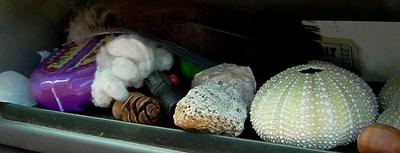
The truck has a cubbyhole space just below the dashboard on the passenger's side. I'm not sure of its intended use, but it's become a sort of mini museum of our travels.

Interesting seeds, cones, feathers, and fossil rocks share space with an old binocular lens cleaner, faded ticket stubs, and the most important of all travel accessories: 6 feet of Bubblegum.

My favorite things though, are the Green Sea Urchin (Stronglyocentrotus droebachiensis) tests (shells).

There were several more, but I've given them away to other nature nuts who expressed an interest. Here are some nice pictures of what the sea urchins looked like when they were alive.

We found these on rocky beaches on our trip to Nova Scotia 5 or 6 years ago.

I'd seen pictures of rocky beaches before, but had never thought about what they sounded like. I'd never heard anyone wax poetic about the whispery clatter of a rocky beach. But now it's one of my favorite sounds. The rocks are very smooth, and tumble against each other with each wave. A beautiful noise.

A few sea urchin facts:
They are circumpolar in northern waters.
I really like the word "circumpolar".
Sea urchin means sea hedgehog.
They are pentamerously radially symetrical.
The raised bumps are where the spines were attached.
Pentamerous is my new word of the day.

Friday, April 2, 2010

Riverbanks Zoo and Gardens~The Zoo

We headed to Columbia today, and our first stop was the Riverbanks Zoo and Gardens. The guys liked the penguin behind them in this picture. He looks like he is hitch hiking.

We have not visited as many zoos as I'd like, because Austin is not a fan of them. He was complaining on the way to this one, telling us that if you've seen one zoo then you've seen them all because it's the same animals over and over again.

While there are many animals that we do see in each zoo, once we were inside the zoo, we were surprised to see that they had quite a few unique animals there. So he joked that he was so glad he talked us into the zoo, because you always see a wide variety when visiting multiple zoos and they are never the same. We should listen to him more often, lol!

We only saw about half of the zoo due to getting distracted by Blue Bell Ice Cream and a visit to the Botanical Gardens, but what we did see was awesome. We loved this zoo!


I overheard something today that had me remembering how hard it is to be a Mom. I think part of why it is so hard, is because you lose all of your brain cells when you give birth to the child. I used to think we gave our brain cells to the child, and that's why we lost them...but as Bill Cosby can verify-that is not the case. So I imagine the brain cells are in that same black hole where socks get lost.


I heard a woman telling a child about four years old one of those things that only a parent would tell a child. While holding a water bottle two inches from his face she said, "If you'd get it...then you'd have it". I saw the child look at her like, wait a minute...let me grab a notebook here so I can be sure to fully grasp this. 1. If I'd get it. 2. Then I'd have it.


No, he didn't really do that. But he did curl his lip at her all Elvis like to indicate just how dumb he thought she was. Ahhhhh....kids...gotta love them. They drive you into a sleepless stupor and then bask in their superiority. I wanted to let him know that once upon a time, before he entered her world, she was brilliant! But I knew he'd never understand until he had children of his own. So I just giggled instead.


Living the life in South Carolina.

Ritual and Repetition

Sunny Day

"Business in the front, party in the back, yeah!!!"


Riding from the grocery store, I stopped on the side of the river path to watch the row boats. A grinning cyclistrode past - pointing at the front, then the rear of my bike in an enthusiastic Contador-style salute.


Huh? Oh! Camera bag, flowers. Got it. But before I could say anything, he was gone.


Sunny Day

Riding to and from work assignments on a warm sunny day feels suspiciously good. Now that the snow is gone, I am making longer trips again, seeing parts of the city and suburbs that I've missed, encountering new characters.


Sunny Day

Grocery shopping can feel like a chore, except on those drawn outafternoons when the sun lingers and lingers.


Sunny Day

Back from a hard road ride, my legs feel too restless to sit. Nothing feels better than spinning on my city bike along the river to fetch some groceries. And flowers, to brighten up the kitchen. Sport, transport. Business, party. Weekdays, weekends.


Little Tree, 3 Months Later

On the way home I stopped to visit the Tiny Tree. We replanted this tree(a Dwarf Alberta Spruce, I am told) in some woods nearby in the first week of January. The ground was clear of snow then and we were lucky to get a warm day, when the soil was soft. I found a spot in a clearing that would get some sun.


Afterward I regretted having planted the tree so close to home: Now I would feel compelled to check up on it. I visited every week. When the snow storms started, it was covered almost to the tip, and I was sure it wouldn't survive the cold. But every time the snow melted, there it was - emerging green as ever. It doesn't look much bigger than it did three months ago. But today I saw some buds resembling baby pine cones.


Have a good weekend, and, as always - thank you for reading!