This is the last stop of the Douro River Valley Tour, a visit to a Port vineyard located in Armamar (Viseu district) along the Douro River and Tedo River just before reaching Pinhao. Maria told us that this estate is a very small, single Quinta A classification. Quinta in Portuguese is equivalent to an estate, hacienda or domaine.
Wine estate classifications runs from A to F with A being the highest. You can find more information here:
Portuguese Quinta Classification Quinta do Tedo on a much better weather (blue skies!) day. Picture from wiemax.comQuinta do Tedo
From my seat in the mini bus (I was sitting in front), I could see Quinta do Tedo coming into view, the estate is perched on top of a hill and is waiting for us. Maria said the views up there are beautiful. I am sure I will not disagree. This part of the Douro River Valley is very peaceful, raw and pure. It was raining when we drove up the private road leading to the estate but when we jumped out of the mini bus, the rain drizzled down a little bit providing us the opportunity to enjoy the breath taking views while we took the obligatory pictures.
The place is soooo lovely, even on a bit gloomy and rainy day!
 There are 3 dogs in the estate but this one is the sweetest. He came to greet us.
 Breath taking views are they not? Even for a bit gloomy day...

The man from the winery welcomed us as we stood there in awe of our surroundings. He told us that the valley we are looking at—35 acres of vineyards including the body of water, all belong to Quinta do Tedo. There are another 22 acres of land planted with olives and fruits that belongs to the estate as well.
Then he urged us to follow him to the cave where they store and age the wines in oak barrels. The cave is located at the other side of the estate and as we rounded the corner, we were again confronted by the beautiful scenery, he had to patiently wait for everyone until we were done snapping pictures. I can probably hear him mutter under his breath, ‘Ah, tourists…’ Haha, he must be used to this.


 Port Wine Cave
Mr. wine man explained to us the aging process of Port wine and all that stuff, yadda, yadda, etcetera. Anyway, there’s a ton of information about Port wine available online for those who are interested. There is google for that so I will not be posting that here. But in this winery, I learned that for Port wine to be called vintage, it must be at least 10 years old. Naturally, the value of a bottle of vintage Port follows its age.
The wine estate is actually now owned by a Frenchman coming from the Bouchard wine growing family in Burgundy, France.

 Isn't she just too cute? This is the little girl of the Japanese couple living in Frankfurt, Germany.


 Here I am smiling reluctantly (disapprovingly!) at the camera because of the bad weather. Unfortunately, after our short Port cave session, it rained again. Here I am walking back to the main part of the building for the next part of the agenda which is the Port tasting.Port Tasting – Vintage is my favourite
I really would have wanted to buy a vintage bottle of Port from this winery but I came by plane with a carry-on luggage. It is also too much of a hassle to have to ship a bottle of wine to the Netherlands but I really enjoyed their vintage here very much. So smooth and elegant.
Read here my entry about the types of Port wine and my visit to the Calem Caves in Vila Nova de Gaia:
Port cave tour and tasting at Calem: You drink Port at the end of the meal! We had a tasting of Port wines, from left to right: 10-year old Tawny, a Ruby 2007 and a Vintage .


The estate also offers Bed & Breakfast accommodation. In fact, many quintas offer this in the Douro River Valley. My wish would be that during the warmer months, I’d be able to come back here and stay in the valley for a few days.
So we have come to the end of the tour and as we drove back to Porto, my last memory of the drive and everything else were these pictures below before I dozed off.

I woked up just in time when we entered Porto. The streets seem to be dry, so I am grinning and hearing hallelujah ringing in my ears. The evening is going to be promising!
Previous entries:
Douro River Valley Tour 4b: Lunch in Peso da Regua at Restaurante Douro InDouro River Valley Tour 4a: The flood in Peso da ReguaDouro River Valley Tour 3: Wine, Cheese and Presunto tasting in LamegoDouro River Valley Tour 2: A rainy and misty 'Douro viewing point' stopDouro River Valley Tour 1: Amarante village, Vinho Verde (green wine) and some Travel Agency rant
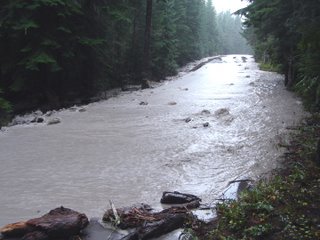 The rain seems to have stopped and now you can hear the Longmire generators (6-10 am and 4-8 pm that is). It's going to take some time to put things back in order, but it seems as though the main brunt of the storm and its damage have subsided.
 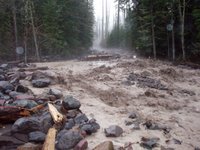 If you're familiar with the park, you'll notice a number of "new viewing areas" along the Nisqually to Paradise corridor next time you visit. The Nisqually River ran bank to bank and in doing so, took a massive amount of debris with it. Large trees fell, as new embankments were chiseled.


 Will Spring ever arrive this year? Looking at all the new snow on the trail as we braved another "spring ride," I began to seriously doubt it. Nonetheless, my Rivendell is back in action after a long winter.
 Now, here's an admission: Although the Sam Hillborne is super-comfortable, when it comes to shorter rides without major hills I've come to prefer a more pared-down roadbike. In fitting the Rivendell with a front rack, decalleur, handlebar bag and good sized saddlebag, we made a conscious decision to optimise it for long distance travel and exploration at the expense of simplicity. Though individually each accessory is fairly lightweight, all together they do add heft to the bike and make it more difficult to take in and out of the apartment. And I find it inconvenient to detach and reattach the bags depending on what kind of ride I am taking, so I would rather just leave them on.
 I have a routine 30 mile ride that I do whenever weather permits, and on this ride my ideal bike would be a lightweight single speed (fixed/free flip-flop hub), with a tiny saddlebag and no fenders. Currently, my Moser and Bianchi share this role, with the Moser being the fixed gear and the Bianchi essentially acting as the freewheel singlespeed, since the 2x6 gearing is so unfinicky that it allows me to forget it's there. By contrast, the 3x8 gearing on the Rivendell feels cumbersome on a ride where I don't need to shift gears.
 I am not the first person to experience the epiphany that "for fast and short rides I prefer Roadbike A, while for long and hilly rides I prefer Roadbike B." Still, I was surprised to feel myself developing this preference - particularly the single speed and no fenders part of it. There is something to be said for just being able to throw a bike down on the grass and not worry, for pedaling fast and not playing around with shifters. At times I value this simplicity and ease more than I value load capacity, gearing, comfort, and yes - even keeping my clothes clean and dry. There, I said it!


