
10 point crampons and tricounis!
Very skilled and hard men.
Best detail account of the original gear used on the Eiger I've seen sin the "White Spider". I knew about the 12 point crampons of Harrer but the rumor of a "short" axe may be not unfounded. A "short axe" in 1938 could have been anything under 95cm.

No question this axe is closer to a 65/70cm than 100cm.
I do not know if the photo aboveare from the actual 1st ascent.

Kasparekon theHinterstoisser
with what looks to be a short North Wall hammer on the 1st ascent.

Heckmair and Vörg. Perfect French technique
of "ax anchor" using whatcould easily be 70cm. axes

Heckmair and crew with him holding his axe after the 1st ascent.
Heckmair was not a tall man and my thought is that axe can't be more than 70cm.
As a modern comparison, Jeff Lowe and Mike Weiss used 70cm Chouinard Piolets as there primary tools on the 1st Ascent of Bridalveil falls.
"The most experienced mountaineer in the group (Heckmair, Ludwig Vörg, Heinrich Harrer and Fritz Kasparek), Heckmair led the most difficult pitches in the ascent, aided by the extensive kit (including new 12-point crampons) that he and Vörg had purchased using sponsors' money. Even as the most experienced climber, he still ran into several problems on the North Face of the Eiger, such as when he slipped whilst climbing out of the exit cracks. Luckily, Ludwig Vörg caught him by his feet, piercing his hand on Heckmair's crampons as he did so."
From the Eiger ascent:
"The same dayKasparek and Harrer ascension began leaving
the two Germans at the base of the wall. After several hours of climbing
reach the Rote Fluh and Hinterstoisser Crossing, which easily crossed by fixed
ropes had left a few weeks before other climbers. Take a snack at a bivouac
conditioning called "Swallow's Nest", where 40m rope stop by if you must back
out there. A lesson learned from the misfortune of Toni Kurz and his
colleagues two years ago."
"The next morning, July 22,
Second face the Snowfield, and
here Harrer no longer fit doubts: he made
a big mistake by not wearing crampons. Fritz
Kasparek is forced into an excess of grief and effort
to go to Harrer carving steps
can follow. And so, slowly move up through the frozen snow diagonal Right to
Left."
"When you are about to finish
the lengthy Second Snowfield, something leaves them amazed. Behind them two climbers are
reaching them at a rate they believe they will run. In seconds they reach.
To his
surprise are Heckmair and Vörg, which come climbing at a stretch from the base
of the wall. As Harrer himself wrote: "... wearing their 12-point
crampons, and I, with my boots winged fly (tricounis), I am out of place ...".
The Germans
advance and come to a head. From that time, fit the ascent and continue climbing 4 more
or less together."
Photos and comments courtesy of:
http://elpioletdemadera.blogspot.com//02/eiger-4-con-anderl-heckmair-al-frente.html
http://elpioletdemadera.blogspot.com//02/eiger-3-julio-del-38-sera-ahora.html


 This week was supposed to be our vacation week. We were going to go down to Ft Myers beach to meet up with some friends and to spend some beach time there as a family. Then I got a job offer to spend the summer at the beach, and I needed our vacation week to work out some of my two week notice. So we took my two days off to go down instead. We landed at Peace River and drove down to Sanibel Island for the day.
 Since we were at Peace River, we also had a too short visit with some very special friends. As soon as we returned from Sanibel Island, Rich and Donna had a cookout for us. I've shared here before how Donna is one of the main reasons I stuck with pickleball. Beyond pickleball, I just enjoy her as a person. She is one of those rare people that is sweet and interesting all rolled up in one.
 Living the life in Florida!
 Late lunch at Stortorget: Räksmörgås and going against the trend pairing it with a red.


 Had lunch at Stortorgskällaren restaurant at the famous old square of Gamla Stan, Stortorget. The skies have started to clear up a bit.
 This was the yummy delicacy I had.... crunchy with lemon flavoured stuff inside.
 At the PUB store, there is a money exchange counter. Swedish Kronas. I almost never have cash in my wallet as I pay by bankcard and creditcard. When travelling it is the same, I just go to an ATM to withdraw if needed.
 Tucker and Caesar are Desi's geldings. Tucker is a big boy. The tallest and heaviest of the horses.
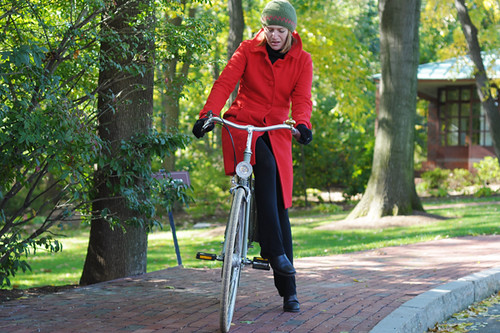 In the past I've been asked to demonstrate my quirky bicycle dismount, so here it is! Over the course of riding step-through city bikes, I've gravitated toward the sideways dismount: swinging my right leg over the frame while the bike is still in motion and then jumping off the saddle to the left as I come to a stop. It'sreally more like a "slideways" dismount, because what I am doing is leaning the bike and sort of dumping myself off the saddle. I've tried to recreate it here in slow motion while testing my camera'sremote control feature (the remote is in my hand - can you tell?).
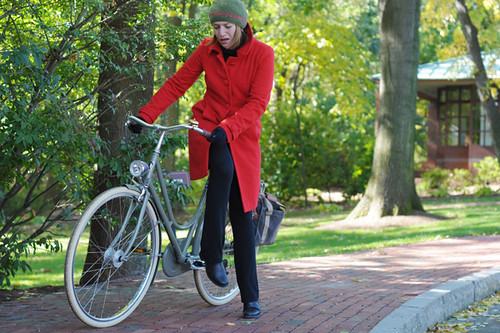 I know others who dismount their bicycles in this manner, and, like me, they find it completely natural and intuitive. But I've also been criticised for this move. A couple of people have told me that doing this to the bike repeatedly might distort the frame. Others have expressed concern that one of these times I am bound to get "tangled in the bike" while swinging my leg over. The latter does not really worry me; my body seems to have an inherent awareness of where the top tube is in relation to my foot. The frame distortion idea is intriguing, but seems far fetched: Can the sideways jump really exert sufficient force to twist these tank-like frames?
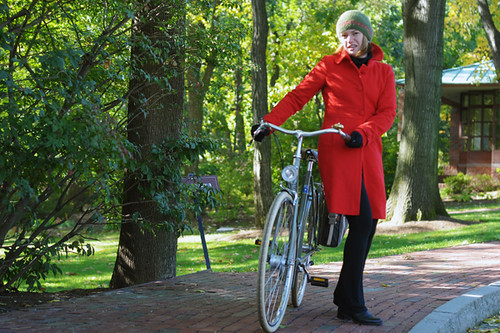 I never set off to adopt this style of dismount; it just sort of happened. As I kept raising the saddles on my city bikes higher and higher, eventually I could no longer reach the ground without leaning the bike to the side. The "slideways" move was the natural outgrowth of that: Somehow I find jumping off in this manner easier and more natural than the typical method of standing up on the pedals and then stepping down. At this point I've been doing it this way for over two years, and it would be a difficult habit to break!


 It was a pretty park, well maintained and clean and I didn't have any “bad vibes” about the place. Large trees provided plenty of shade from the hot sun and there was a nice breeze. All in all it was very pleasant.
 The rather idyllic view across the river from my campsite.
 All of the rivers and streams in that area are full to brimming, flowing swiftly. There were quite a few waterfalls as well, many with several cascades, such as this one at South Creek Falls on Mountain Road 99 in the Sequoia National Forest.
 There is no way that you can capture their immensity in a photograph. Of course, that didn't stop me from taking pictures!
 At one time, these were three individual trees. I found it interesting that Sequoias gain their full height in the first 300 years at which time they aren't all that big around. As the years pass, they (like most of us humans) get bigger around. And, if they are growing close to others, they could, as these have done, join together. The boy standing between the two trees on the left is about four feet tall.
 One of the things that surprised me regarding these trees is that the bark (or outer layer) is spongy. It gives when pressed upon. This tree has a portion of the outer bark layer missing, but it was still alive and growing.