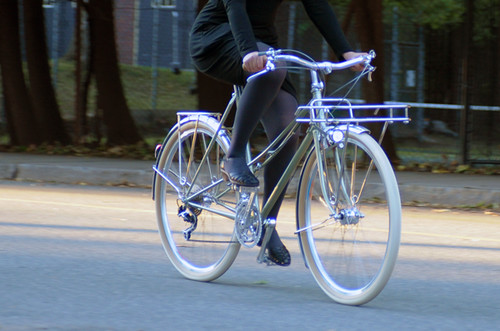
In cycling, some associate skill and experience with being able to go fast. But going slow - and I mean really slow, like walking pace - can be even more difficult. When I first began riding as an adult, I could not keep my bike upright at super-slow speeds. I remember that the steering was hard to control; I'd end up losing my balance and having to stop. Even a couple of years down the road, it was easier to ride at 20mph than at 2mph. But finally I got the hang of it, and today I am able to ride at walking speed with no trouble at all.
Looking back on this, I would say that slow cycling is one of the most useful bicycling skills I have picked up so far. Here are just some of the practical applications I've noticed over the years:
Wobble-free starting
When I talk to novices about cycling for transportation, a common theme that comes up is the fear of swerving into traffic when starting from a stop at a light. You can see it in the city: When some riders push off from a stop, the front end of their bike will wobble before they gain sufficient momentum to proceed in a straight line. Now, some bikes are easier to balance at slow speeds than others, but with sufficient skill even a twitchy bike can be ridden at walking speed wobble-free, eliminating this anxiety.
Navigating traffic
Riding in the city can be all about stop and go traffic. Being able to cycle slowly while maintaining full control of the bike makes this easier to handle, allowing the cyclist to maintain momentum and to travel more efficiently. Particularly useful is what I think of as "hovering." This is a practice that is somewhere between trackstanding and riding at walking pace. It comes in handy when inching your way forward in a line of stopped cars, changing lanes in dense traffic, waiting to turn left at an intersection, or proceeding in ambiguous right of way situations. It is much easier to both show your intent and accelerate from a position of hovering than it is from a stopped position.
Safe MUP sharing
It used to drive me nuts to ride on crowded mixed use paths. Finding it stressful to navigate around hordes of unpredictable pedestrians, I would simply avoid MUPs during peak hours. But the greenways around here are quite scenic and can be relaxing if riding slowly is not an issue. The same "hovering" skill I find useful in road traffic works just as well for meandering amidst joggers and dog walkers.
Riding on dirt and uneven surfaces
Cycling through muddy, rocky and otherwise challenging terrain can reduce a bike's speed considerably. Yet keeping your balance and being able to steer the bike precisely is more important than ever in those conditions. My new-found enjoyment of unpaved riding has much to do with improved slow cycling skills.
Thinking back to how I finally learned all of this, two distinct experiences come to mind. First, riding fixed gear. I remember vividly how the fixed drivetrain made me feel dramatically more in control of the bike at slow speeds. No one was there to instruct me; it was as if the bike itself was teaching me. And after getting my body used to balancing on the fixed bike that way, some of that eventually transferred over to freewheel bikes.
But the real change was a result ofinstructional paceline rides. These rides taught me a number of useful techniques, including how to maintain continuous pedaling and consistent cadence regardless of speed. To ride slowly, we were instructed to switch into a low gear while pedaling and feathering the brakes, instead of coasting. This taught me to maneuver the bike smoothly, to control my speed with precision, and to stay stable even when moving at a crawl. Somehow pedaling made all of this easier and reprogrammed my body to balance with the bike. Almost immediately, I saw major improvements in my everyday bike handling skills.
If fixed gear bikes and paceline rides are not for you, one thing you could try is this: When out riding, pay attention to your pedaling. To slow down, try switching into a low gear while pedaling continuously, instead of coasting while pedaling in a high gear occasionally. To slow down even more, feather the brakes while continuing to pedal. Try to go slower and slower using this technique.Gradually your body will learn to maneuver the bike at slow speeds, whether pedaling or coasting.Learning to ride slowly transformed me as a cyclist; it is a skill I highly recommend picking up.


 The entrance welcomed me and I knew that I was in a very special place. Thankfully, it also had a campground!
 The Stockett House and outbuildings.
 The First Baptist Church.
 Each building has a sign which provides a brief history.
 The prefabricated house of Colonel Allensworth, delivered by railroad and assembled in 1911.


 How cool! I went to read the Yehuda Moon comic strip last night, and something on the website looked very familiar.
 It took a while for it to hit me, but those are my photos used as examples of the Van Sweringen Flickr group. Thanks, Yehuda! So nice of you to pick my photos. From left to right, they are: Somervillain's Raleigh DL1, the Co-Habitant's Raleigh DL-1, and the Co-Habitant's Pashley.
 The Co-Habitant's "track bike". I guess the


 As I drove further west, the weather got better!


 As members of the Austin Film Society Philo & I occasionally get to see movies before they're released. A couple of weeks ago we saw Stardust, which opened on Friday. The trailers made me think of old favorites like Time Bandits , Willow, and The Princess Bride, where the tongue is held firmly in cheek as the hero wields his weapon. Stardust did resemble those movies, but with modern computer effects and sensibilities reflecting changing social attitudes. I liked how the movie looked on the screen, large and romantic with some lovely sweeping views. Claire Danes and Charlie Cox play the hero and heroine, but with Robert De Niro out-Depping Johnny, and Michelle Pfeffer shedding her leading-lady skin to emerge as a wickedly funny villainess, the young actors have to fight for leading status. This is not a great movie, but I think it's a good one - and it was lots of fun to see it with a summertime audience in an airconditioned theater - I even got the souvenir poster above to bring home.
  When the Austin Film Society sent a notice for a screening of Werner Hertzog's new movie, Rescue Dawn, I told Philo about it so he could act fast and snag a pair of tickets. Philo really liked the 1997 documentary Little Deiter Wants To Fly, about Dieter Dengler's experience as a prisoner and eventual escapee in Laos during the Vietnam War. My husband wanted to see the new fictionalized version but was surprised to hear that I did. It kind of surprised me, too - but I'd heard about the documentary from Philo, heard interviews about both movies with Terry Gross on NPR and most compelling of all - it starred Christian Bale and Steve Zahn. That's one reason I can't be a movie critic - I like actors way too much to be impartial.


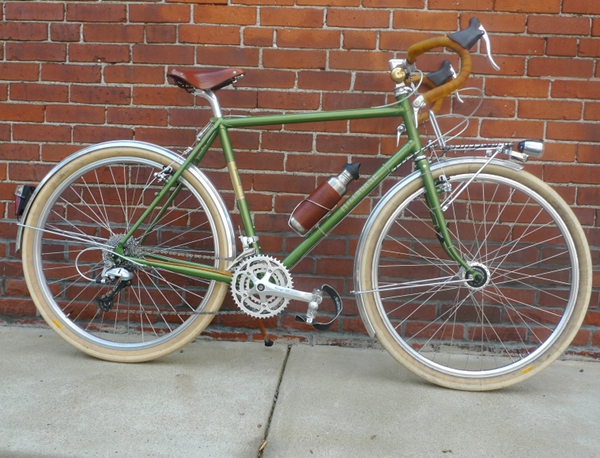
 In preparation for the eventual acquisition of a handlebar bag, Graham has now been fitted with a front rack (Nitto M-18 from Renaissance Bicycles). I have been planning to purchase a front rack for a while, yet had no idea that there were so many choices and that the whole thing is so complicated.
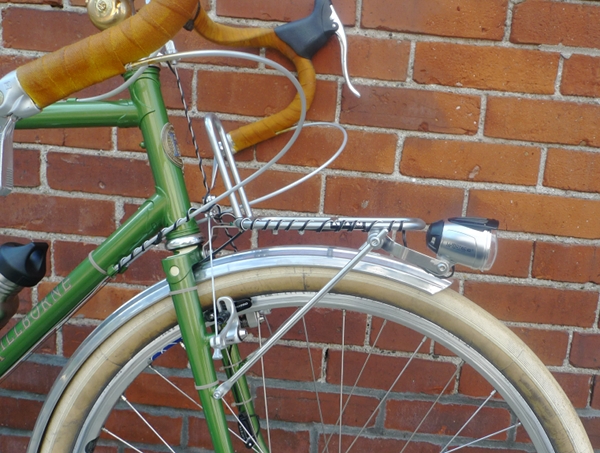 To determine which front rack your bicycle needs, several things must be taken into consideration:
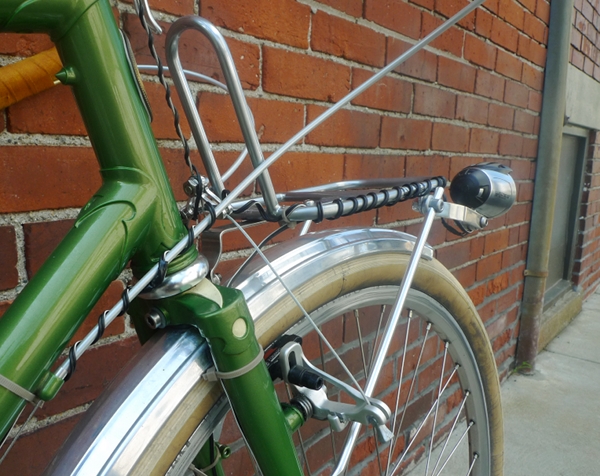 But wait, that is not all: You must also consider your brakes. Even if the rack you choose does not mount onto the brakes themselves, it can be incompatible with a given type of brakes (in particular, cantilevers) due to clearance issues. Don't forget to check up on this!
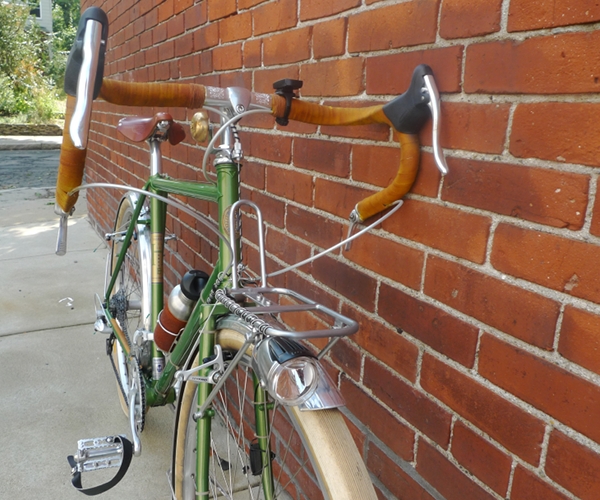 Exhausted yet? I feel spent just writing about this! And I haven't even raised the question of aesthetics yet. If you look at the front racks closely, you will notice that some are square (like the Nitto M-18 in my pictures), while others are round. If you have a rear rack installed on the bike, it may be important to you that the two match - in other words, that both are square or both are round. So that is yet another design element to watch for.
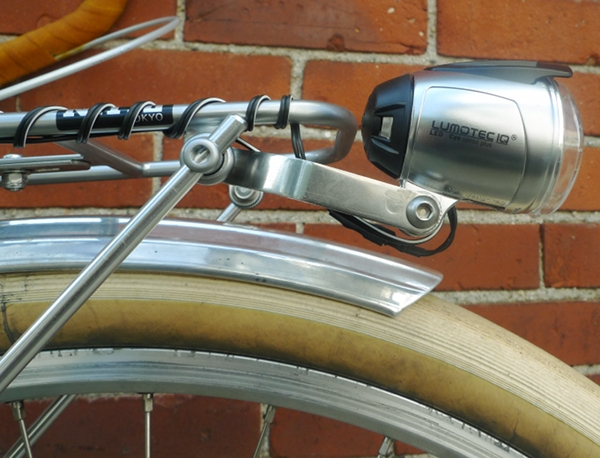 Last but not least, there is the question of light placement. Some racks are made with little braze-ons for mounting lights. The Nitto M-18 is not. So we bought a VO light mount - which is basically a small metal bracket with two holes. The size of the holes was not compatible with either the rack's or the headlight's bolts, so we had to drill them out.
 I am also not sure how I feel about the garlands of wiring that now seem to cover the bicycle's front end like ivy. Once the handlebar bag is installed the wires on the rack will not be visible, but what about the section that curls around the shifter cable? All in all, I cannot say that this set-up can be called "elegant" and we are still considering alternatives. One thing I do like, is how far forward the light extends - this placement seems ideal for road illumination. Is it a matter of compromise, or is there a magical solution out there that I am overlooking?
 We have successfully re-routed the wiring, so that it now runs straight underneath the rack instead of coiling around it.
 We have also titled the bracket down, placing the headlight a little further back, which should reduce the vibrations. I will remove theNittosticker when I get around to it.
 "Aerial" view.
 The wires are considerably less noticeable this way, and I think the results are good. Thanks for everybody's comments and suggestions.