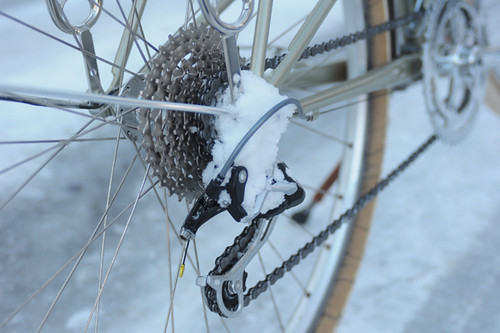
There are good reasons to recommend snow-proof bikes for winter cycling: powdercoat, hub brakes, internal gearing, single speed fixed. However, some prefer to stick with a regular bike through the winter, eitherforspeed, economy or other reasons. That is my situation right now, and so far even limited riding in the snow has given me a pretty good showcase of things to watch out for. Here are some of them:
Snow and rim brakes:
This is an important one for safety. If you ride through snow and it builds up on your wheel rim, you can lose braking power on a bike with rim brakes. After riding through snow, I try to remove it from the front rim as soon as I notice any build-up, before it has a chance to freeze. This can be done fairly quickly: First I bounce the front wheel forcefully, then spin it as I wipe the snow off with a gloved hand.
Snow and the derailleur:
If your bike has derailleur gearing and you get the derailleur covered in snow, it can solidify and impair shifting. I was surprised to see how quickly snow can build up and freeze around that area; I guess there are a lot of convenient nooks and crannies for it to get into. To remove it, I shake off the rear wheel and free the derailleur from buildup with gloved fingers. I also try to stay in a low-ish gear in case the shifting goes. I would be reluctant to leave a derailleur-geared bike locked up outdoors in the snow for any length of time without some sort of cover.
Fender clearance:
This is not a popular opinion to have in transportation cycling circles, but fenders can be a pain. Unless there is a generous (as in vintage 3-speed/ Dutch bike type of generous) amount of clearance between the fender and tire, snow can get in there and does not always want to come out. If enough snow builds up, it can slow down the wheel's rotation or even bring it to a halt. I have experienced this on a couple of bikes now (granted, after intentionally riding them through snow for fun), bikes with what is considered good fender clearance for paved and dirt road riding in normal weather. Once snow gets between the tire and fender, it can be fairly difficult to remove on the road in cold temperatures; it doesn't want to be coaxed out. Better to avoid riding through soft snow in the first place.
Salt and rust:
Bicycles that are finished with anything but the hardiest powdercoat are susceptible to rust from the salted winter streets. The damage starts out as cosmetic - which is in itself sad if you have a nice bike -and can grow to become structural over time. I wipe my bike down after every ride on salted roads to avoid this. I would not leave a delicately finished bike outdoors in the winter for any significant length of time.
While not ideal, it is not impossible to ride a liquid painted, derailleur-geared bike with rim brakes and less than generous fender clearances in the snow, if you take care to watch for build-up en route and if you maintain the bike afterward. Storing such a bike outdoors in the snow is more problematic. Your bike parking situation at home and work could be the determining factor in whether going without a winter-proof bike is doable.

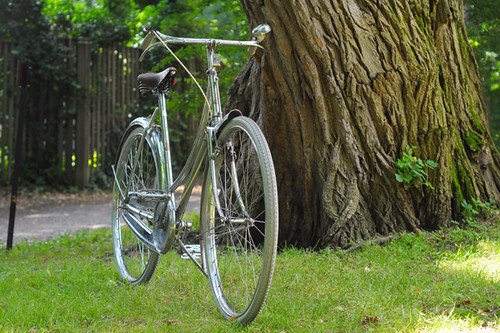
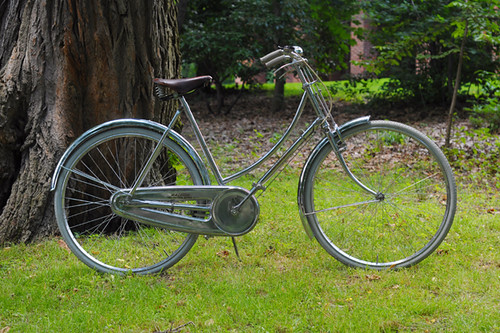

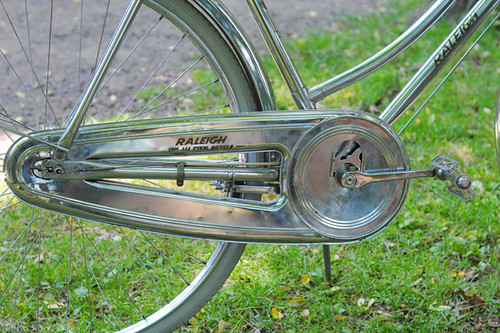
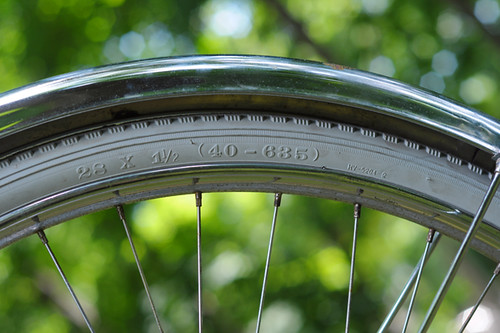
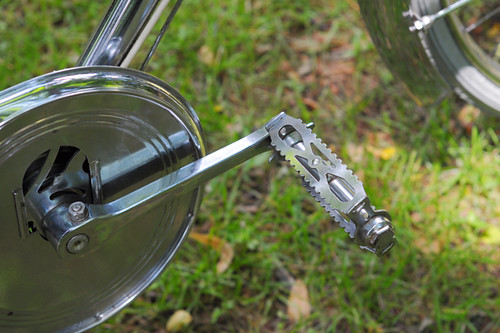


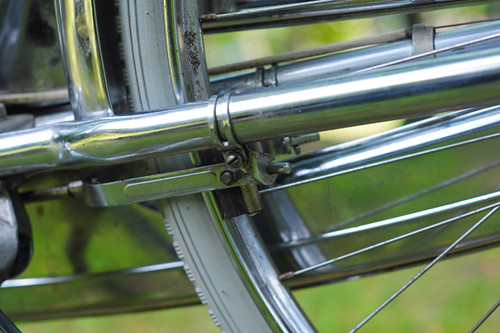
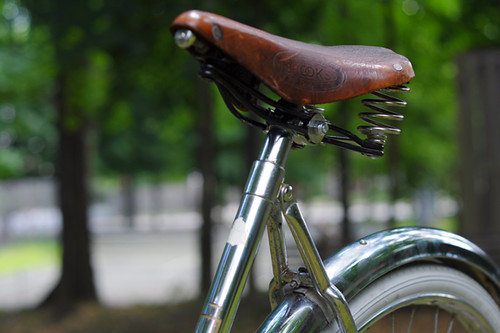
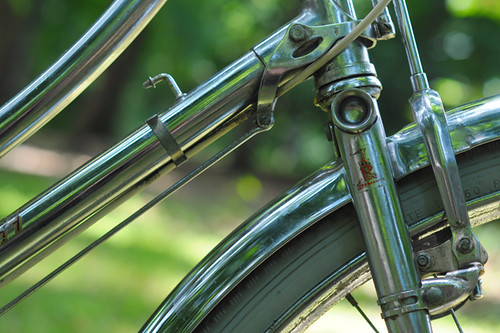
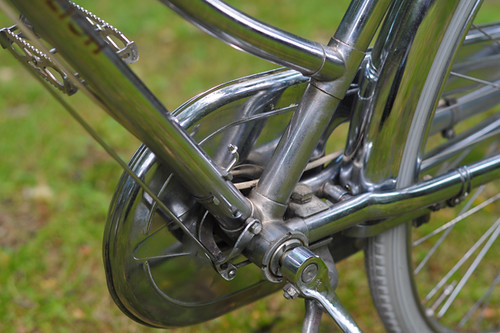
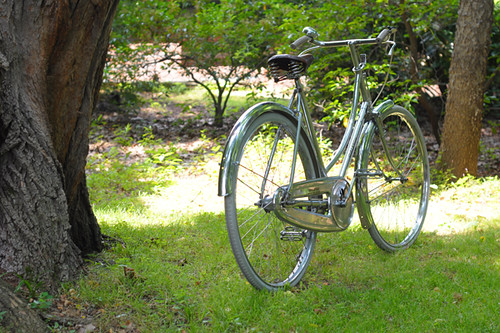


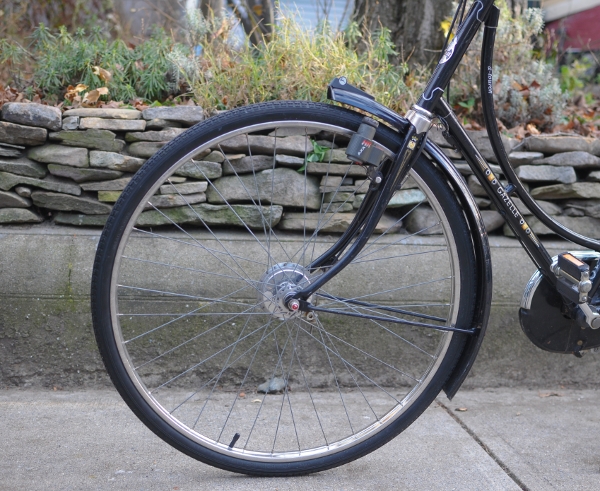 The phrase "fork's bent" has become a private joke of sorts in vintage bicycle circles. Almost any time somebody posts a picture of their "awesome vintage find," there will be that one person who comments that "the fork looks bent." Most of the time, the fork is not bent and it's just something to say - or maybe the angle or the lighting in the picture are misleading. Nonetheless, the possibility of a bent fork or frame is certainly something to watch for in vintage bikes. If a bicycle is steel, a bent frame or fork is not necessarily tragic - steel is flexible and the bent portion can usually be straightened. Cracks, on the other hand, are of greater concern.
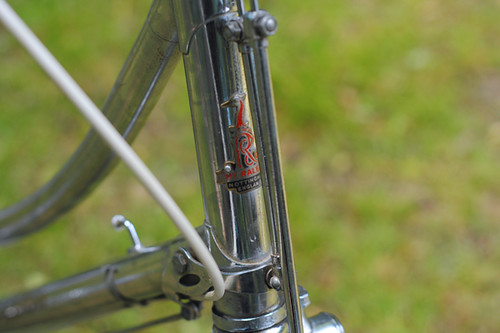
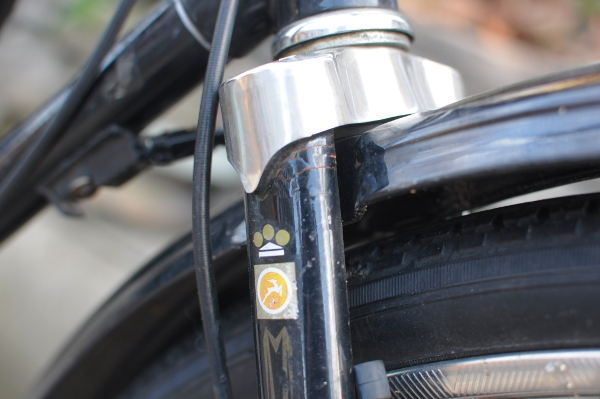 During my visit to Geeekhouse last week, the guys were looking at my Gazelle and pointed out that the bits of cracked paint underneath the fork crown could indicate cracks in the surface of the fork itself. Needless to say, my heart sank.
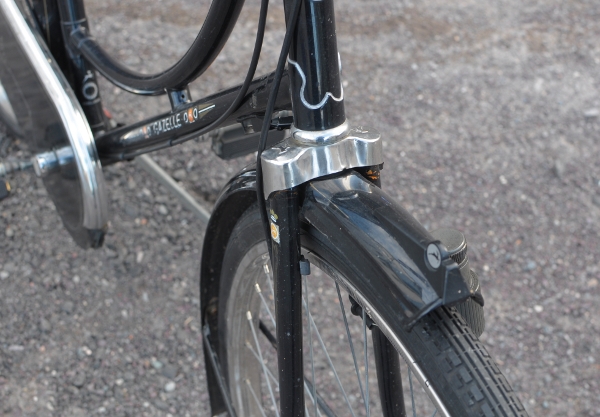 I noticed the cracked paint before, but didn't think anything of it. The fork blades in of themselves are not deformed and there are no indicators that the front end of the bike has been in a collision. In an impact strong enough to bend the fork, surely there would have been some other damage - but there is not a scratch anywhere. The bicycle also handles absolutely fine - better than fine - with no indication of anything "off" in the steering.
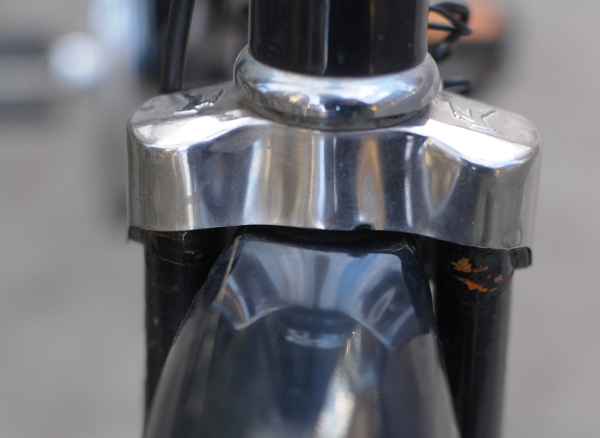 It would be easy to dismiss the cracked paint, if it were not for one red flag: The cracks are symmetrical - right underneath the fork crown, on both the right and the left blade. How did they get there, and how can we tell whether it really is just cracked paint or an indicator of some sort of trauma to the fork?
 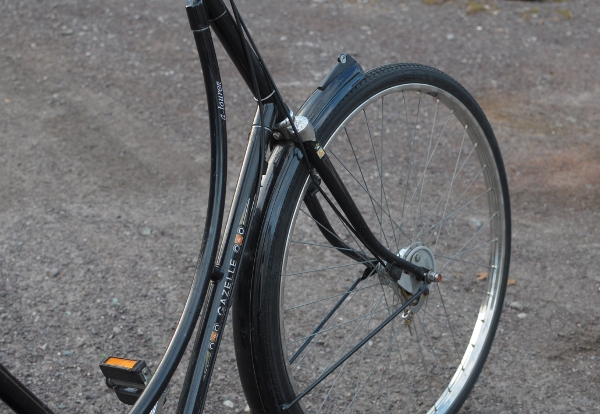 I was speaking to a local frame-builder yesterday, who advised to check for similar paint cracks in the back of the fork blades. There are none; the paint is cracked only in the front. To him, this was an indicator that the fork could be fine - as stress fractures typically happen in the back and not in the front of the blades. He also pointed out that even if the fork has been bent and reset, or even if there are hairline cracks, a massive Dutch fork like this can probably take it, without it being a safety issue. No doubt there are loads of people in the Netherlands riding ancient beaters with visibly bent forks.
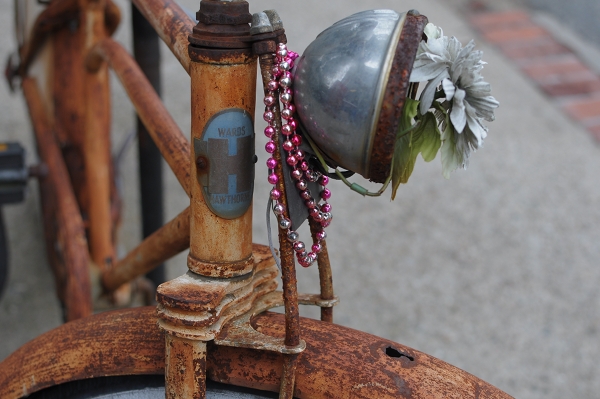 When getting a bicycle, whether new or vintage, it can be nice to personalise it - to make alterations here and there, so that the bike feels distinctly "ours". I am often asked for advice regarding various aspects of this process, from budget, to component choices, to colour coordination. And while these things are highly personal, there are several general points that I propose keeping in mind.
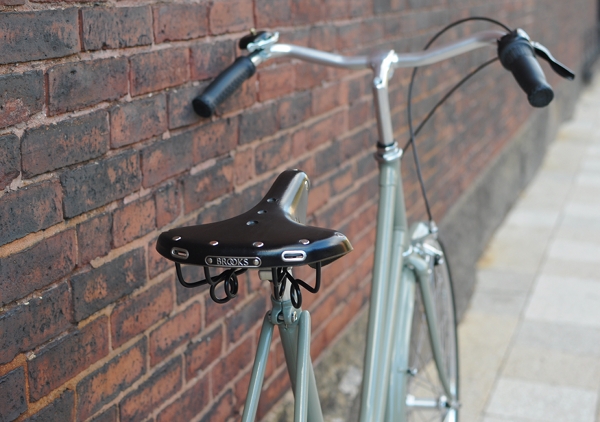 1. Address functionality and comfort before looks. Prior to buying colourful panniers and covering the bike with flower garlands, make sure the saddle position and handlebar height are properly adjusted for your proportions and postural preference. You may be surprised how much just that factor alone can change the "personality" of the bicycle. And this, in turn, will better inform subsequent aesthetic choices.
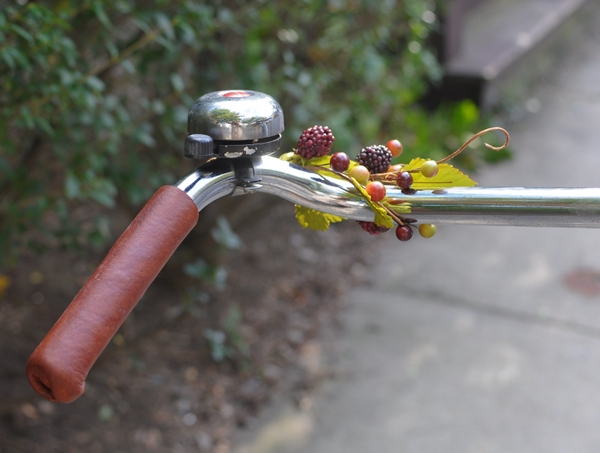 2. Personalising the looks of your bicycle need not involve buying lots of costly accessories. Some of the most delightful decorations are also the least expensive. Consider that things like ribbon,faux florals,twine, and stickers can cost mere pocket change. A simple bow in your favourite colour on the handlebars, or some flowers along the edge of your basket, will create an instant, lively transformation. And if you have an old bicycle with scratched up paint? You could turn it into a "zebra bike", "tiger bike", or "bumble bee bike" by wrapping appropriately coloured electrical tape around the frame to create stripes.
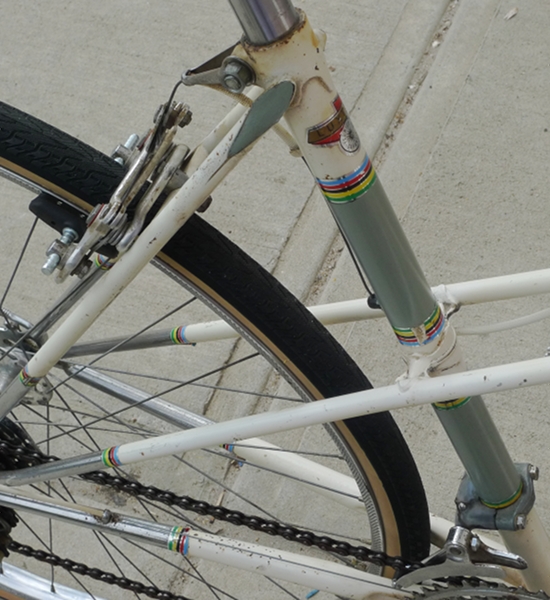 Of course, with an older bicycle there is also the option of using paint. You could trylug outlining, hand-painting small panels, or even paintingyour own designs along the entire frame. In Europe I see bicycles hand-painted with flowers, polka-dots, zebra stripes, peace symbols, lady bugs, and all sorts of other simple motifs.A paint pen for lug outlining will set you back around $2. Enamel paint will cost around $6 for a small can.
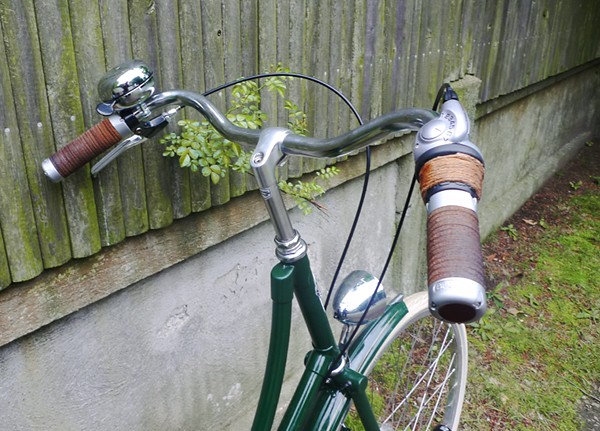 3. Avoid formulaic accessorising. If you saw it in a magazine or on a popular blog, chances are that so did hundreds of others. Do you really want to spend all that money on limited edition saddles, deluxe grips and exotic tires, just to end up with a bicycle that looks identical to lots of other bikes? Take the time to consider what combination of things would suit you individually, rather than trying to recreate a popular look.
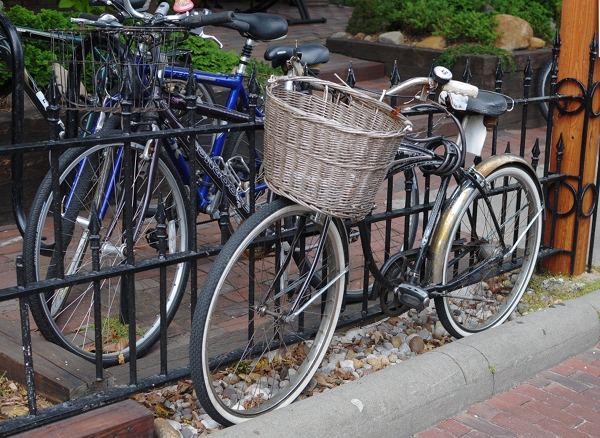 In the end, the bicycles that are the most striking and feel the most "yours" are those that reflect your personality - regardless of the budget that went into achieving that.


 Living the life in Virginia!
 The road to Colyer Cemetery, Marion Township, Douglas County, Kansas. Looking to the north.
 The Fisher plot, looking to the northwest. The two barrell-shaped stones are for Lucretia and Samuel.
 LUCRETIA A. FISHER / BORN AUG. 23, 1845 / DIED OCT. 31, 1909
 SAMUEL FISHER / 1840 – 1913 / CO. A. 9 KAS. VOL. CAV.
 FOOTSTONE.
 See detail below.
 OUR MOTHER